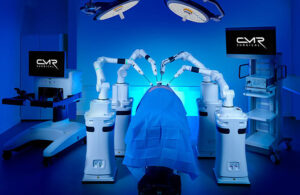
The alliance comes shortly after Medtronic agreed to put $700 million into Cornerstone Robotics and its Sentire system, which it pitched as a complement to its in-house Hugo robot as the company doubles down in its global competition with industry leader Intuitive and newer entrants like Johnson & Johnson.
CMR’s multi-port, cart-based Versius features a modular design that’s angling for easier integration into existing surgical programs and a wider variety of operating room architectures, including outpatient ambulatory surgical centers. The Cambridge, U.K.-based company first entered the U.S. market earlier this year, following a 2024 de novo clearance from the FDA.
“Soft-tissue robotics is a high-growth adjacency and a natural extension of Stryker’s strengths in endoscopy, visualization and enabling technologies,” the president of Stryker’s medical surgical and neurotechnology group, Andy Pierce, said in a statement. “We have evaluated the segment carefully for years, and this alliance represents a thoughtful and disciplined entry that combines the complementary strengths of both companies.”
“We selected CMR Surgical and the Versius portfolio because of the opportunity to help healthcare providers grow robotic-assisted surgery adoption across a broad range of procedures in hospitals and ASCs,” added Pierce, who also claimed a seat on CMR’s board of directors as part of the deal.
Related: CMR Surgical, Nvidia showcase predictive surgical robotic capabilities
CMR’s latest-generation Versius Plus received its U.S. greenlight late last year, starting with gallbladder removal procedures. A gynecology indication for non-cancer surgeries is currently under review. The system carries wristed, 5 mm instruments and 3D imaging capabilities.
The company has said its robots have been used in more than 45,000 procedures internationally, and described it as the second-most used system outside the states. Analysts have pegged its future usage will be split between about 60% in-hospital and 40% within ASCs.
Stryker has previously targeted outpatient robotics with its Mako orthopedic platforms — now spanning knee, hip and shoulder replacements, as well as spinal procedures — which it acquired in 2013 for $1.7 billion. Mako also gained new implant and powered instrument additions earlier this year.
This month, Stryker announced that long-time CEO Kevin Lobo will step down at the end of the year, passing the torch to Chief Operating Officer Spencer Stiles. Lobo will continue to serve as executive chair.
