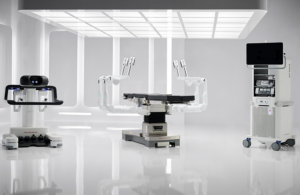
Authorization covers multiple procedures across general surgery, including Roux-en-Y gastric bypass, gastrectomy, cholecystectomy, splenectomy, gastric sleeve, small bowel resection, appendectomy, lysis of adhesions, fundoplication, and hiatal hernia repair.
J&J submitted the robot to the FDA for de novo approval in January. In May, the company said Ottava met its endpoints in a pivotal study.
The FDA’s green light marks a significant milestone for Johnson & Johnson and Ottava, nearly six years after first unveiling the soft-tissue platform that it hopes will challenge longtime leader Intuitive Surgical’s da Vinci system. It also marks the second major surgical robot approval within the last year, as Medtronic’s Hugo also got an FDA nod for urologic procedures in late 2025.
News of the FDA authorization for Ottava comes a day before kickoff of the Society of Robotic Surgery’s annual meeting, which runs July 23–26 in Fort Lauderdale, Florida.
J&J plans to commercially launch Ottava with select customers in the U.S. It intends to focus on early customer success while working to advance into additional indications and regulatory jurisdictions over time. The company currently has a U.S. clinical trial underway for Ottava in inguinal hernia procedures.
Learn more about the fast-growing surgical robotics space in our 2026 MassDevice Surgical Robotics Special Report. Download the report for free here.
More about the Ottava surgical robot
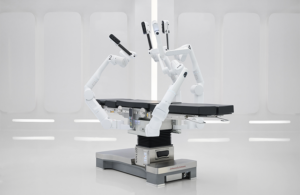
Ottava incorporates four robotic arms into a standard-size surgical table. Its unified architecture allows for an invisible design, J&J says. The robotic arms are available when needed and stowed beneath the surgical table when not. It occupies 30–50% less space than traditional boom- and cart-mounted systems, the company says.
The robotic system offers sophisticated software controls to coordinate its arms, enabling automated, pre-defined procedural poses to simplify setup and breakdown. It has twin motion (the synchronized motion of the table and arms) capabilities for seamless patient repositioning and multi-quadrant access to the anatomy with limited intraoperative adjustments.
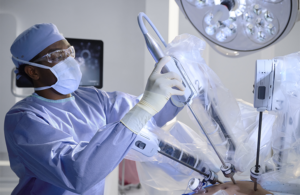
Johnson & Johnson said it optimized Ottava’s instrumentation for robotic surgery. The system features a two-in-one needle driver designed to reduce unintended suture cutting. It also has monopolar curved scissors for consistent and complete cuts.
The technology connects with the Polyphonic digital ecosystem to support teams throughout the Ottava experience. Polyphonic brings learning, media and data-driven insights together to support continuous improvement across the surgical journey.
Commentary from Johnson & Johnson leadership
Tim Schmid, EVP, worldwide chair, MedTech, said:
Hani Abouhalka, company group chair, Surgery, MedTech, said:
“Surgical robotics will play an increasingly important role in surgical care, but it’s clear that what defined the last 25 years of surgery will not define the next 25. By opening up the way we think about architecture, data, and the very workflows of surgery itself, we have designed Ottava to deliver clinical and economic benefits and support surgeons and hospitals as the future of surgery unfolds.”
Dr. Peter Schulam, chief scientific officer, MedTech, said:
“Variability of surgical outcomes remains a challenge in healthcare. While surgical robotics has helped augment surgical skill, the next generation of care must also integrate data and insights across the surgical ecosystem to support surgeon judgement and help improve patient outcomes. Ottava was designed with that connectivity in mind.”