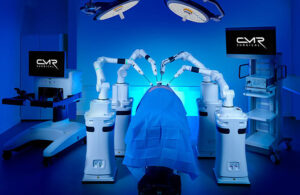
The Cambridge, UK-based company is demonstrating what it labels as a “new paradigm of simulation in surgical robotics at” at SRS 2026. It said the demonstration shows Versius Plus when trained to learn from clinical experience to predict how the future surgical environment could evolve under different actions.
Versius became the first multi-port, soft tissue general robotic-assisted surgical device to gain clearance through the FDA’s de novo process in 2024. CMR added FDA clearance for its next-generation Versius Plus system in cholecystectomy in December 2025.
CMR Surgical’s technology leverages Nvidia’s Isaac for Healthcare’s Medical Physics Simulation, Cosmos-H-Dreams. This shows how the system could help guide surgeon decision-making and potentially improve patient outcomes. Last fall, the company became an early adopter of Nvidia’s IGX Thor platform for surgical robotics. Earlier this year, it announced a new effort with Nvidia to train the next generation of intelligent surgical systems.
Leveraging Versius Plus, CMR Surgical said the new capabilities make it the largest contributor to Open-H Embodiment, the world’s largest open dataset for healthcare robotics.
Cosmos-H-Dreams real-time simulation is fine-tuned for Versius Plus using Open-H-Embodiment open data along with the Cosmos world foundation model. This action-conditioned model, built on Nvidia’s physical AI infrastructure, takes the current surgical scene along with a proposed action by the robot. It then predicts what the operating field could look like after that action.
Commentary from CMR Surgical and Nvidia officials
Chris Fryer, chief technology officer at CMR Surgical said:
“Versius Plus gives us the foundation to explore the next generation of intelligent surgical systems. Today, surgical robots are tools in the operating room. Our vision is to build on global surgical data to create systems that can provide surgeons with deeper insight, help anticipate future scenarios and support better-informed decision making. This simulation is an important step towards that future.”
David Niewolny, Head of Business Development for Healthcare and Medical Technology at NVIDIA, said:
“True surgical intelligence requires the ability to learn and adapt. By combining NVIDIA Isaac for Healthcare Medical Physics Simulation to CMR’s rich clinical insights, developers can create virtual training environments that mirror the complexity of human anatomy. This enables developers to generate diverse surgical scenarios and evaluate robotic behaviour at scale, accelerating the path toward more intelligent surgical robotics.”