Healthcare systems are under pressure. Clinicians are asked to diagnose and treat quicker with fewer resources.

Stryker (NYSE: SYK) Medical President Jessica Mathieson believes these problems make the current state of healthcare unsustainable. But she says Stryker’s new SmartHospital platform aims to address these challenges and make healthcare professionals’ jobs easier.
“Across Stryker, all of our innovators have always been focused on understanding our customers across all the different call points, their biggest challenges,” Mathieson said.
Mathieson’s been with Stryker for over 17 years. First as an account manager before serving as business unit director, VP and GM of the company’s Acute Care division. She was promoted to president of Stryker Medical in 2024 and oversaw the division’s launch of SmartHospital this year.
Mathieson joined our DeviceTalks Weekly podcast to explain how Stryker’s acquisition of Vocera and Care AI proved essential in the development of its new communications and monitoring operational platform, SmartHospital, and how it’s already impacting the workforce.
Addressing healthcare’s biggest challenges
SmartHospital is an AI-driven operating system designed to improve hospital workflow and reduce operational complexity by connecting devices, data and care teams onto a single digital ecosystem.
“The SmartHospital platform is not a single product or solution,” Mathieson said. “It is a foundational platform that brings together five core capabilities.”
The platform stems from Stryker’s newly formed Smart Care business unit, established inside the company’s $4-billion-a-year Medical business to provide customers with digital healthcare technology.
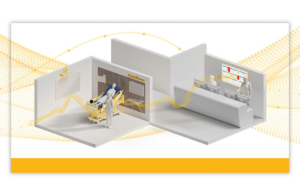
SmartHospital supports clinical and operational workflows across the patients entire care journey from transport, treatment and recovery by connecting over 85 Stryker products such as its ProCuity bed, Vocera hands-free communication devices, Engage workflow engine, virtual nursing and ambient monitoring systems.
Just five years ago, Stryker didn’t have the portfolio to create the comprehensive version of SmartHospital that debuted this March. Mathieson’s unit had been focused on innovations that limited adverse events related to bed falls, but she said the company knew it needed to expand and explore digital solutions to improve patient safety and ease cognitive burden.
“We knew we had to think bigger,” Mathieson said. “Other divisions, including medical, have been helping solve our customers’ problems around adverse events, patient satisfaction and staff safety for years …we had to understand the inefficient workflows that were happening across the continuum of care.”
Acquiring Vocera
Stryker’s shifted focus toward advancing its digital offerings spurred the company’s $3.1 billion acquisition of Vocera Communications in 2022. Vocera’s portfolio included software and hardware solutions that complemented its offers, Stryker said at the time of acquisition.
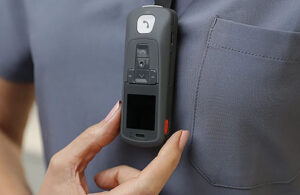
Vocera had advanced communication technology such as its Smartbadge, a hands-free, wearable communication device with a voice command function. Three years later, in 2025, Stryker unveiled a next-generation hands-free communication device, Sync Badge. The device is now a core element of SmartHospital’s digital network.
Sync Badge was engineered to enhance efficiency and improve patient outcomes by allowing healthcare providers to remain hands-on with patients and assemble team members for assistance with enhanced voice commands inspired by Smartbadge.
Mathieson called Engage an “intelligent workflow orchestration” middleware that addresses challenges associated with cognitive burden by filtering information alerts so that the necessary caregivers receive the right information, while also filtering alerts to limit alarm and information overload.
“If you stand in the hallway of an ICU or emergency department, you will quickly recognize the amount of information that care teams are receiving every single minute,” Mathieson said. “Some of that information is critical in regards to the patients that they’re responsible for. Some of that information they don’t need.
“Engage helps us get the right information to the right caregiver,” she said.
Stryker also designed Sync Badge to curb workplace violence. The device has a discreet panic button that broadcasts a message to security teams with the employee’s location and a listening function so security could hear what’s happening in the employee’s environment.
Acquiring Care.ai
Stryker made expanding its connected care portfolio a significant part of its business strategy following its success in the Vocera acquisition.
Delivering on its plan, Stryker acquired Care.ai, a Florida-based company specializing in AI-powered ambient monitoring and virtual workflow technology in 2024. Two years later, Care.ai became a cornerstone in Stryker’s SmartHospital platform.
“Vocera and Care.ai together are our SmartHospital platform,” Mathieson said.
Read more about Jessica Mathieson’s advice for building a career in medtech here.
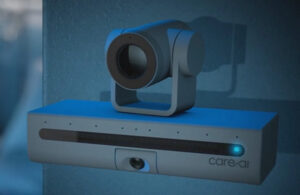
The technology begins with a care.ai camera featuring ambient intelligent sensors mounted on a hospital room wall. The camera passively monitors patients detecting changes in behavior, motion and the presence of others. The sensors capture real-time data, infer patterns and identify deviations using AI-driven algorithms and notifies healthcare providers if a patient needs attention.
“If a patient becomes agitated and they’re a fall risk, the model can recognize that,” Mathieson said. “If physical therapy comes in and doesn’t turn the bed alarm on, the model will recognize this and alert a nurse.
“We’re understanding what is happening in those environments, and then proactively communicating to care teams if there is risk and something must be addressed.”
Mathieson said ambient intelligence “adds awareness without adding burden.”
Care.ai’s virtual nursing builds on SmartHospital’s ambient monitoring technology to address workload. Remote nurses based at a command center can simultaneously monitor, assess and support up to 10 patients using real-time data from ambient monitoring.
Listen to Jessica Mathieson’s full interview on our DeviceTalks Weekly podcast.
Virtual nurses can admit and discharge patients, speak with family members and assist in documentation and administrative tasks according to the hospital’s protocols and standards.
Mathieson views virtual nursing as a driver in addressing staff retention issues, and she said nurses near retirement are asking to move into virtual nursing units to prolong their careers.
“We are removing the burden from [nurses’] day-to-day,” she said. “We’re saving them time. We’re saving them minutes. We’re able to take some of the less clinical tasks off of them. It’s very much a retention tool … [and] a pathway to extend their careers.”
What’s next?
Stryker’s rooted knowledge in clinical and operational workflows and experience in medical devices and hardware, position the company to become a key player in medical technology innovation and a desirable partner for customers, Mathieson said.
“We know the regulated space, but now we understand the healthcare information technology space,” she said.
Since healthcare operations technology such as SmartHospital, isn’t regulated like medical devices, Mathieson said the industry is moving faster without regulatory roadblocks. Stryker hopes to add additional offerings to its SmartHospital platform within the next three years and tackle more of healthcare’s challenges.
“We’re moving faster in this space. We’re innovating faster,” Mathieson said. “As we think about software releases, they’re at a pretty significant cadence in regards to how often we’re releasing new features and new upgrades.”
DeviceTalks Editorial Director Tom Salemi contributed to this report.