• Skip to primary navigation
  • Skip to main content
  • Skip to primary sidebar
  • Skip to footer

MassDevice

The Medical Device Business Journal — Medical Device News & Articles | MassDevice

  • Special Reports
  • Technologies
    • Artificial Intelligence (AI)
    • Cardiovascular
    • Orthopedics
    • Neurological
    • Diabetes
    • Surgical Robotics
  • Business & Finance
    • Wall Street Beat
    • Earnings Reports
    • Funding Roundup
    • Mergers & Acquisitions
    • Initial Public Offering (IPO)
    • Legal News
    • Personnel Moves
    • Medtech 100 Stock Index
  • Regulatory
    • Food & Drug Administration (FDA)
    • Recalls
    • 510(k)
    • Pre-Market Approval (PMA)
    • MDSAP
    • Clinical Trials
  • Resources
    • About MassDevice
    • Leadership in Medtech
    • Manufacturers & Suppliers Search
    • MedTech100 Index
    • Videos
    • Webinars
    • Whitepapers
    • Voices
    • In-Depth Coverage
    • Latest News
  • Attend DeviceTalks
    • Events
      • DeviceTalks Minnesota – May 4
      • DeviceTalks Boston – May 27–28
      • DeviceTalks West
      • DeviceTalks Tuesdays
    • DeviceTalks Podcast Network
      • DeviceTalks Weekly
      • AbbottTalks
      • Boston ScientificTalks
      • DeviceTalks AI
      • IntuitiveTalks
      • MedtechWOMEN Talks
      • MedtronicTalks
      • Neuro Innovation Talks
      • Ortho Innovation Talks
      • Structural Heart Talks
      • StrykerTalks
  • Advertise
  • Subscribe
Home » GE HealthCare begins new global partnerships to advance theranostic imaging technology

GE HealthCare begins new global partnerships to advance theranostic imaging technology

October 22, 2026 By Skyler Rivera

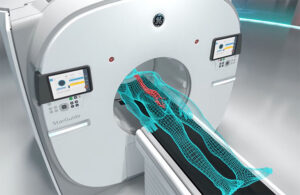
An illustration of GE HealthCare’s StarGuide SPECT/CT technology in use.
The five global clinical evaluation programs will study GE HealthCare’s StarGuide SPECT/CT technology. [Image courtesy of GE HealthCare]
GE HealthCare (Nasdaq: GEHC) will collaborate with five global clinical evaluation programs to evaluate its StarGuide GX SPECT/CT platform and gain insights to advance next-generation theranostic imaging technology.

“Nuclear medicine is entering a new era in which imaging is expected to do more than identify disease – it is increasingly being used to quantify biological processes, support treatment decisions and monitor response to therapy,”  GE HealthCare Molecular Imaging Executive Director Erez Levy said in the announcement.

“By working across multiple regions and care environments, we aim to generate clinical and research insights that can help inform innovation as imaging, quantitation and workflow needs evolve,” he said.

The five internationally recognized programs are Mayo Clinic (US), Hadassah Medical Center (Israel), Oncopole Claudius Regaud – Institut Universitaire du Cancer de Toulouse (France), Peking University First Hospital (China) and Rambam Health Care Campus (Israel).

These programs will evaluate the GE HealthCare StarGuide GX 4D SPECT/CT system for image quality, quantitative performance, dynamic imaging and workflow. They’ll provide clinical and research-driven feedback to advance the next generation of theranostic imaging technology.

Related: GE HealthCare and Mayo Clinic collaborate on novel cancer treatment research study

Each participating program will evaluate the platform from different care settings. Mayo Clinic will evaluate advanced quantitative and dynamic imaging applications, while other institutions will focus on areas such as SPECT/CT platforms in routine oncology imaging and clinical research; explore novel tracer research and preclinical applications; and StarGuide GX’s imaging workflows.
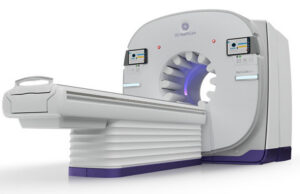
The GE HealthCare StarGuide GX 4D SPECT/CT system
The GE HealthCare StarGuide GX 4D SPECT/CT system [Image courtesy of GE HealthCare]
“The technological innovations introduced by StarGuide GX are particularly exciting for the future of theranostics,” Oncopole Claudius Regaud – Institut Universitaire du Cancer de Toulouse Head of Imaging Frederic Courbon said in the announcement.

StarGuide GX utilizes dual-sided cadmium zinc telluride detector technology to produce high-sensitivity, high-resolution imaging and wuantititative imaging, the company says.

The system’s configuration enables the detectors to move close to the patient during. Its dual-collimator detector design is intended to eliminate manual external collimator exchanges and streamline imaging workflows, GE Healthcare says.

Related: GE HealthCare’s on-site cyclotron for PET agent production claims CE Mark

“The system’s ergonomic design and flexibility have the potential to significantly improve workflow while supporting precision in quantitative imaging and high-energy radionuclide applications,” Courbon said. “Our first experience suggests that StarGuide GX represents a meaningful step forward in enabling advanced theranostic practices.”

StarGuide GX supports a wide energy range of radionuclides, and in research settings, the system could help evaluate imaging radionuclides associated with emerging alpha-emitter research and further expand theranostic applications.

The collaborations advance GE HealthCare’s work with University Hospital Essen in Germany, which was the site of the first StarGuide GX SPECT/CT installation. The next-generation theranostic imaging system received CE Mark in November 2025 and is awaiting 510(k) clearance with FDA.


Filed Under: Business/Financial News, Diagnostics, Featured, Health Technology, Hospital Care, Imaging, News Well, Oncology, Research & Development Tagged With: Cancer, GE Healthcare, Mayo Clinic, Theranostics

More recent news

  • GE HealthCare begins new global partnerships to advance theranostic imaging technology
  • Siemens Healthineers, Nvidia launch radiotherapy AI collaboration
  • J&J, Medtronic present pulsed field ablation data from global real-world use
  • Abbott sets Libre Duo glucose-ketone sensor US launch for December
  • Edwards wins FDA approval for Pascal Precision in tricuspid valve repair

About Skyler Rivera

Skyler Rivera is an associate editor at Arrowfly, covering medical device industry news and technology at MassDevice and Medical Design & Outsourcing. She began her career covering sports at The Athletic and MLB before transitioning to medical writing at Edwards Lifesciences. Based in Southern California, she holds a master's degree in science writing from Johns Hopkins University and a bachelor’s in broadcast journalism from Syracuse University. Connect with her on LinkedIn or email at [email protected].

Primary Sidebar

“md
EXPAND YOUR KNOWLEDGE AND STAY CONNECTED
Get the latest med device regulatory, business and technology news.

DeviceTalks Weekly

See More >
MDO ad
MDO ad

Footer

MASSDEVICE MEDICAL NETWORK

DeviceTalks
Drug Delivery Business News
Medical Design & Outsourcing
Medical Tubing + Extrusion
Drug Discovery & Development
Pharmaceutical Processing World
MedTech 100 Index
R&D World
Medical Design Sourcing

DeviceTalks Webinars, Podcasts, & Discussions

Attend our Monthly Webinars
Listen to our Weekly Podcasts
Join our DeviceTalks Tuesdays Discussion

MASSDEVICE

Subscribe to MassDevice E-Newsletter
Advertise with us
About
Contact us

Copyright © 2026 · Arrowfly LLC and its licensors. All rights reserved.
The material on this site may not be reproduced, distributed, transmitted, cached or otherwise used, except with the prior written permission of Arrowfly.

Privacy Policy