
• Skip to primary navigation
  • Skip to main content
  • Skip to primary sidebar
  • Skip to footer

MassDevice

The Medical Device Business Journal — Medical Device News & Articles | MassDevice

  • Special Reports
  • Technologies
    • Artificial Intelligence (AI)
    • Cardiovascular
    • Orthopedics
    • Neurological
    • Diabetes
    • Surgical Robotics
  • Business & Finance
    • Wall Street Beat
    • Earnings Reports
    • Funding Roundup
    • Mergers & Acquisitions
    • Initial Public Offering (IPO)
    • Legal News
    • Personnel Moves
    • Medtech 100 Stock Index
  • Regulatory
    • Food & Drug Administration (FDA)
    • Recalls
    • 510(k)
    • Pre-Market Approval (PMA)
    • MDSAP
    • Clinical Trials
  • Resources
    • About MassDevice
    • Leadership in Medtech
    • Manufacturers & Suppliers Search
    • MedTech100 Index
    • Videos
    • Webinars
    • Whitepapers
    • Voices
    • In-Depth Coverage
    • Latest News
  • Attend DeviceTalks
    • Events
      • DeviceTalks Minnesota – May 4
      • DeviceTalks Boston – May 27–28
      • DeviceTalks West
      • DeviceTalks Tuesdays
    • DeviceTalks Podcast Network
      • DeviceTalks Weekly
      • AbbottTalks
      • Boston ScientificTalks
      • DeviceTalks AI
      • IntuitiveTalks
      • MedtechWOMEN Talks
      • MedtronicTalks
      • Neuro Innovation Talks
      • Ortho Innovation Talks
      • Structural Heart Talks
      • StrykerTalks
  • Advertise
  • Subscribe
Home » GE HealthCare’s on-site cyclotron for PET agent production claims CE Mark

GE HealthCare’s on-site cyclotron for PET agent production claims CE Mark

October 15, 2026 By Conor Hale

GE HealthCare (Nasdaq: GEHC) has claimed a European approval for a relatively compact, self-shielded cyclotron designed for the local production of the rapidly decaying isotopes used in PET imaging tracers. 

The CE Mark for the MINItrace Magni enables the in-house supply of fluorine-18 — the molecule used to power GE HealthCare’s Flyrcado, Cerianna and Vizamyl agents — as well as the standards of carbon-11, oxygen-15 and nitrogen-13.

At the same time, the company said its PETtrace cyclotron’s solid target platform will expand into copper-64 production for research use, a metal isotope GE HealthCare said could form the basis for future diagnostic and therapeutic agents in areas such as prostate cancer and HER2-positive breast cancer.

“The molecular imaging landscape is being reshaped by the expansion of theranostics, the introduction of new PET tracers, and demand across oncology, neurology and cardiology,” said Erez Levy, GE HealthCare’s VP of molecular imaging. “That calls for a longer-term view of radiopharmaceutical production — one that supports established services while allowing institutions to prepare for new clinical and research applications.”

According to the company, the MINItrace Magni includes a three-click workflow and carries a footprint of 7.2 square meters. It automatically prepares the cyclotron and its targets and tunes the radiation beam. Many PET isotopes have short half-lives and a small delivery window, requiring them to be produced as close to patients as possible in some cases. 
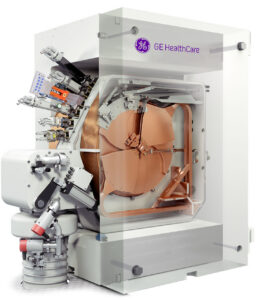
GE HealthCare's MINItrace Magni
The MINItrace Magni [Image courtesy of GE HealthCare]
Earlier this month GE HealthCare put down $945 million to acquire Sofie Biosciences, aimed at bolstering its last-mile logistics for radiopharmaceuticals. Sofie, with its U.S. network of 15 contract manufacturing sites and 21 cyclotrons, previously worked with the company to produce its Flyrcado injection (flurpiridaz F-18) for cardiac PET imaging. 

Sofie has also been co-developing its own F-18 radiotracer with its future owner. Currently being studied in phase 3 trials as a diagnostic for pancreatic cancer and gastroesophageal tumors, its 110-minute half-life gives it about eight hours of travel time. 

Meanwhile, the expansion of PETtrace’s solid target platform will add copper-64 to the production of gallium-68 and zirconium-89, with the latter making its debut earlier this year. Cu-64 is being studied in combination with the more powerful isotope Cu-67: the former is delivered first to highlight tumors on a PET scan, while the latter’s radiation is strong enough to kill the cancer cells.

Filed Under: Cardiovascular, Featured, Imaging, Neurological, News Well, Oncology, Radiosurgery/Radiation therapy Tagged With: GE Healthcare, PET scans, radiology

More recent news

  • GE HealthCare’s on-site cyclotron for PET agent production claims CE Mark
  • Heart implant maker BioVentrix withdraws plans for Nasdaq IPO
  • FDA warns of Philips ultrasound issues after four patient deaths
  • FDA approves Gore bridging stent graft in complex aortic aneurysms
  • Steris inks $2.1B deal for operating room supplier Xodus Medical

Primary Sidebar

“md
EXPAND YOUR KNOWLEDGE AND STAY CONNECTED
Get the latest med device regulatory, business and technology news.

DeviceTalks Weekly

See More >
MDO ad
MDO ad

Footer

MASSDEVICE MEDICAL NETWORK

DeviceTalks
Drug Delivery Business News
Medical Design & Outsourcing
Medical Tubing + Extrusion
Drug Discovery & Development
Pharmaceutical Processing World
MedTech 100 Index
R&D World
Medical Design Sourcing

DeviceTalks Webinars, Podcasts, & Discussions

Attend our Monthly Webinars
Listen to our Weekly Podcasts
Join our DeviceTalks Tuesdays Discussion

MASSDEVICE

Subscribe to MassDevice E-Newsletter
Advertise with us
About
Contact us

Copyright © 2026 · Arrowfly LLC and its licensors. All rights reserved.
The material on this site may not be reproduced, distributed, transmitted, cached or otherwise used, except with the prior written permission of Arrowfly.

Privacy Policy