
• Skip to primary navigation
  • Skip to main content
  • Skip to primary sidebar
  • Skip to footer

MassDevice

The Medical Device Business Journal — Medical Device News & Articles | MassDevice

  • Special Reports
  • Technologies
    • Artificial Intelligence (AI)
    • Cardiovascular
    • Orthopedics
    • Neurological
    • Diabetes
    • Surgical Robotics
  • Business & Finance
    • Wall Street Beat
    • Earnings Reports
    • Funding Roundup
    • Mergers & Acquisitions
    • Initial Public Offering (IPO)
    • Legal News
    • Personnel Moves
    • Medtech 100 Stock Index
  • Regulatory
    • Food & Drug Administration (FDA)
    • Recalls
    • 510(k)
    • Pre-Market Approval (PMA)
    • MDSAP
    • Clinical Trials
  • Resources
    • About MassDevice
    • Leadership in Medtech
    • Manufacturers & Suppliers Search
    • MedTech100 Index
    • Videos
    • Webinars
    • Whitepapers
    • Voices
    • In-Depth Coverage
    • Latest News
  • Attend DeviceTalks
    • Events
      • DeviceTalks Minnesota – May 4
      • DeviceTalks Boston – May 27–28
      • DeviceTalks West
      • DeviceTalks Tuesdays
    • DeviceTalks Podcast Network
      • DeviceTalks Weekly
      • AbbottTalks
      • Boston ScientificTalks
      • DeviceTalks AI
      • IntuitiveTalks
      • MedtechWOMEN Talks
      • MedtronicTalks
      • Neuro Innovation Talks
      • Ortho Innovation Talks
      • Structural Heart Talks
      • StrykerTalks
  • Advertise
  • Subscribe
Home » GE HealthCare and Mayo Clinic collaborate on novel cancer treatment research study

GE HealthCare and Mayo Clinic collaborate on novel cancer treatment research study

July 9, 2026 By Skyler Rivera

A photo of clinicians tending to a patient inside a CT scan.
Mayo Clinic will also be the first U.S. site to investigate the potential benefits of GE HealthCare’s next-generation SPECT/CT StarGuide GX technology. [Photo courtesy of Mayo Clinic]
GE HealthCare (Nasdaq: GEHC) and Mayo Clinic are collaborating on a novel research study aimed at advancing personalized cancer treatment, the medical device developer and academic research center announced.

The Molecular Imaging Biomarker-Based End of Therapy Trial (MI-BET) is a novel theranostics study, designed to explore a personalized approach to radioligand therapy (RLT) for patients with advanced prostate cancer.

“This collaboration is an example of how Mayo Clinic leads in discovery by integrating novel technologies into our practice and accelerating innovation across research and clinical care to advance the future of medicine,” said Mayo Clinic Chief Business Development Officer Andrew Danielsen in a news release.

“By bringing together complementary expertise and capabilities, we can enable our world-class researchers and physicians to develop new insights, expand treatment possibilities, and ultimately provide the best outcomes for our patients globally,” he continued.

Related: Siemens Healthineers, Mayo Clinic collab to treat neurodegenerative disease

Radioligand therapy is an emerging treatment within theranostics, combining targeted radiopharmaceutical diagnostics and therapies that allow clinicians to identify and treat cancer with greater precision, the news release said.

Right now, patients undergoing RTL follow a standardized, preset number of treatment cycles, according to the release. MI-BET is designed to evaluate whether imaging and biomarker-informed insights can support a more personalized approach to cancer treatment.
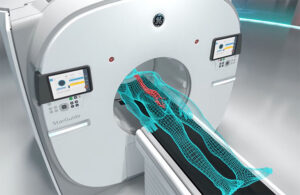
An illustration of GE HealthCare’s StarGuide SPECT/CT technology in use.
GE HealthCare’s StarGuide SPECT/CT technology will be used to track tumor response to treatment during the study. [Image courtesy of GE HealthCare]
The study will use GE HealthCare’s StarGuide SPECT/CT technology and MIM Software’s MIM LesionID Pro to track tumor response to treatment throughout therapy. Mayo Clinic’s research team will use combined insights from imaging data, clinical outcomes and blood-based biomarkers to help inform treatment decisions.

“Making theranostics truly adaptive and personalized requires strong clinical evidence and a deeper understanding of how patients respond to therapy,” said GE HealthCare Global Theranostics GM Sergio Calvo. “Through our collaboration with Mayo Clinic, we are exploring how imaging and data-driven insights can help inform more individualized treatment decisions, support the broader adoption of these approaches and contribute to the continued growth of precision care in oncology.”

Insights from the study could also potentially support the development of predictive markers for patients’ response to treatment. Predictive marker insights could allow researchers and clinicians to anticipate how a patient will respond before or early in treatment, enabling care teams to make adaptive treatment decisions, the release said.

“Personalizing therapy is both a scientific pursuit and an opportunity to expand patient access,” Chair of the Radiopharmaceutical Trial Team at Mayo Clinic, Dr. Geoffrey Johnson said. “Theranostics, and studies such as MI-BET, give us an important opportunity to rethink how and when we treat cancer. By evaluating response earlier in their treatment, we can generate data to drive approaches that could help reduce unnecessary therapy while expanding access to care for wider populations.”

Related: GE HealthCare earns FDA nod for AI-enabled radiotherapy tech

The collaboration and trial support a broader goal of expanding access to advanced, the release said. The study design encourages broad participation through patient outreach, collaboration with community and advocacy groups and uses approaches, like telemedicine, that could help reduce barriers to enrollment and engagement.

MI-BET research and related activities will be based at Mayo Clinic’s campus in Rochester, Minnesota. Mayo Clinic will also be the first U.S. site to investigate the potential benefits of GE HealthCare’s next-generation SPECT/CT StarGuide GX technology, including exploring the potential for reducing scan time and increasing the precision of tumor assessment. StarGuide GX is currently not cleared by the FDA but has received the CE mark.


Filed Under: Business/Financial News, Clinical Trials, Diagnostics, Featured, Imaging, News Well, Oncology, Research & Development Tagged With: Cancer, GE Healthcare, Mayo Clinic, Theranostics

More recent news

  • Abbott sets Libre Duo glucose-ketone sensor US launch for December
  • Edwards wins FDA approval for Pascal Precision in tricuspid valve repair
  • Danaher’s Masimo acquisition offsets drops in respiratory diagnostic sales
  • Intuitive stock slides as US procedures slow amid $450M settlement
  • Abbott to spin out Nutrition business, cuts guidance

About Skyler Rivera

Skyler Rivera is an associate editor at Arrowfly, covering medical device industry news and technology at MassDevice and Medical Design & Outsourcing. She began her career covering sports at The Athletic and MLB before transitioning to medical writing at Edwards Lifesciences. Based in Southern California, she holds a master's degree in science writing from Johns Hopkins University and a bachelor’s in broadcast journalism from Syracuse University. Connect with her on LinkedIn or email at [email protected].

Primary Sidebar

“md
EXPAND YOUR KNOWLEDGE AND STAY CONNECTED
Get the latest med device regulatory, business and technology news.

DeviceTalks Weekly

See More >
MDO ad
MDO ad

Footer

MASSDEVICE MEDICAL NETWORK

DeviceTalks
Drug Delivery Business News
Medical Design & Outsourcing
Medical Tubing + Extrusion
Drug Discovery & Development
Pharmaceutical Processing World
MedTech 100 Index
R&D World
Medical Design Sourcing

DeviceTalks Webinars, Podcasts, & Discussions

Attend our Monthly Webinars
Listen to our Weekly Podcasts
Join our DeviceTalks Tuesdays Discussion

MASSDEVICE

Subscribe to MassDevice E-Newsletter
Advertise with us
About
Contact us

Copyright © 2026 · Arrowfly LLC and its licensors. All rights reserved.
The material on this site may not be reproduced, distributed, transmitted, cached or otherwise used, except with the prior written permission of Arrowfly.

Privacy Policy