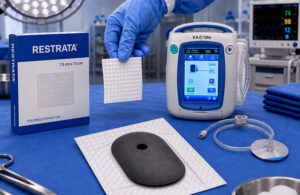
The first piece involves the Restrata resorbable fiber matrix that Solventum acquired late last year through its $900 million purchase of Acera Surgical. Restrata’s synthetic, electrospun material supports soft tissue formation without the use of growth factors, by acting structurally similar to a human extracellular matrix.
Solventum will now pair Restrata with its V.A.C. negative pressure wound therapy, to help create a local environment that further promotes wound healing and maintains close contact between the fiber matrix and the wound bed.
“This indication brings those needs together in a single approach, giving clinicians another option to support healing more effectively across the course of care,” Dr. Matthew MacEwan, co-founder and chief science officer of Acera Surgical, said in a statement.
In addition, the company said Restrata’s longer absorption profile aligns with V.A.C.’s seven-day peel-and-place dressings, where collagen-based products may degrade prematurely and require more frequent changes.
The FDA’s 510(k) clearance also allows Restrata matrices to be used in combination with Solventum’s V.A.C. Ulta Therapy Unit and Granufoam dressings and kits.
Restrata was first cleared in 2017 for use in partial and full thickness wounds, including from surgery or trauma, as well as in ulcers and pressure sores. It picked up an expanded green light in June 2025 adding its use in implantation for soft tissue reinforcement, such as under skin closures for plastic and reconstructive procedures.