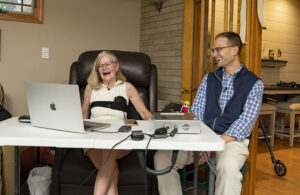
The woman received a diagnosis of a progressive motor neuron disease about 10 years ago, in a group of conditions that includes amyotrophic lateral sclerosis and primary lateral sclerosis. Now in her 60s, it has severely affected the muscles of the mouth and throat, resulting in limited and slurred speech.
Using Paradromics’ Connexus BCI, her brain’s impulses were translated wirelessly by the computer, and she first chose the sentence: “Okay, I have a lot to say.”
According to the company, during the same session she also used the system to communicate with family members and speak with her grandchildren on a live phone call.
Based in Michigan herself, she’s the first in a feasibility study that plans to enroll up to 10 participants for the procedure at sites including the University of Michigan in Ann Arbor, as well as at Massachusetts General Hospital in Boston and the University of California, Davis.
The Connexus device is designed to operate similarly to other durable neurology implants, such as deep brain stimulators for conditions like epilepsy or Parkinson’s disease, placed through a craniotomy. It includes a larger control unit placed under the skin of the chest, with a small sensor threaded onto the surface of the brain’s motor cortex, and no wires through the skin.
That neural interface is densely packed with more than 400 electrodes capable of high-resolution recordings, and Paradromics has set a target device lifetime of at least a decade.
“The goal is to reproduce normal human communication as faithfully and naturally as we can,” Paradromics Chief Clinical Officer Dr. William Marks told MassDevice in an interview. That includes exploring semantics like a person’s cadence of speech and their tone, and essentially turning over the system to the participant is the first step.
“We started with these templated training tasks, such as, ‘Think about these words, and attempt to say these sentences,’ where it’s purely a training model, and the participant gets no feedback,” said Marks, who joined the company this summer. “Then we went to a system where she did these templated tasks, and we presented back to her either on a screen or audibly what the decoded output was.”
That training process has included thousands of words and sentences. “But the really heartening event was when we said, ‘Okay, it’s your turn. Just use the system to communicate.’”
Dr. Matthew Willsey, a University of Michigan Health neurosurgeon and an investigator for the company’s Connect-One trial, asked the participant what she would say to someone considering the procedure, after undergoing it herself in June. She responded: “Don’t be afraid. It’s a wonderful experience to be able to help others by your participation in the research study,” the company said.
According to Marks, the system’s electrodes have been able to identify brain activity associated not only with instructions to muscles for forming speech, but also characterize those linked to internal thoughts and the act of listening to words.
He said that instead of a weeks-long, active training process, the company will explore the idea of having the participant simply listen to an audiobook as a first step for instructing the interface how to decode their neural signals.
“We’re really excited to explore that because it’s all about how we make this technology accessible for people,” he said.
In August, Paradromics received a go-ahead from the FDA to expand the types of devices that could be connected to its interface, such as personal laptops, tablets and phones. In the future, the company also plans to explore the implant’s uses in other areas of the brain, for potentially controlling a prosthetic or robotic arm.