The procedures took place at The Panama Clinic in Panama City, Panama. Dr. Vitor Mendes Pereira led the cases along with local principal investigator Dr. Anastasio Ameijeiras Sibauste.
“With the success of these aneurysm procedures, XCath’s system has demonstrated the potential to enhance human performance and bring a new level of precision to complex neurovascular cases,” Pereira said. “By standardizing fine movements and decision execution, robotic assistance can help transform even junior or less experienced physicians into consistent, low-risk interventionists—ultimately improving outcomes and minimizing complications.”
Houston-based XCath said it marks the second time a surgical robot was used in an intracranial neurovascular intervention. The company said it makes its EVR system the only endovascular robotic system currently in development that achieved intracranial navigation or neurointerventional treatment. It also makes it the world’s first triaxial neurovascular robot to perform treatment, according to a news release.
Dr. Fred Moll, cofounder of surgical robotics leader Intuitive Surgical and the man widely considered the “father of surgical robotics,” is the chair of XCath’s board. The company is targeting a space that has generated recent interest, including a partnership between Stryker and Siemens Healthineers.
“It was exciting to witness this momentous occasion,” Moll said. “The successful completion of these procedures marks a significant milestone in the world of endovascular robotics as we seek to improve outcomes for patients impacted by aneurysms and strokes. These conditions affect a significant patient population, and the ability to perform such intricate robotic interventions has the potential to revolutionize treatment for these vulnerable individuals.”
More about the XCath robot and its recent procedures
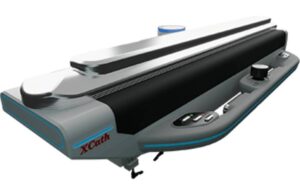
EVR, designed as a bedside endovascular device manipulator for local procedures, enables control over various devices through a console. It can deliver sub-millimeter precision robotic control with an innovative configuration, according to XCath’s website.
The company designed EVR for compatibility with a range of guidewires, catheters and treatment devices. Its cassette controller uses a dexterous positioning arm, easily installed using the system cart. A remote physician unit can also reduce radiation exposure, while interventionalists can avoid exerting continuous force on the musculoskeletal system.
XCath performed the first public demonstration of a simulated, remote mechanical thrombectomy (MT) in 2024. Pereira performed that procedure from AbuDhabi on a simulated patient in South Korea. He removed a blood clot in the brain in minutes. The company then conducted the world’s first telerobotic MT on an animal in February 2025, it says. Earlier this year, it partnered with Nvidia to advance its surgical robot as well.
In the cases completed in Panama, physicians navigated EVR precisely through the patient’s brain vessels. They performed three aneurysm treatments using commercially available flow-diverting stents and intrasaccular devices made by different device manufacturers. The physicians used standard endovascular access devices throughout the procedures.
Two robot procedures took place consecutively in the same operating room over a period of just over four hours. XCath said it marked the world’s first neurovascular robotic procedures with a monoplane angiographic imaging system.
“Unlocking clinical and commercial value in neurointervention starts with making life-saving intracranial care more replicable, more precise and more accessible when every minute counts,” said Eduardo Fonseca, CEO of XCath. “As we look to the future, the success of a trial with this level of clinical complexity lays a strong foundation for commercially viable local and telerobotic neurointerventions that improve patient outcomes.”

