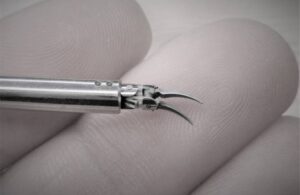
The FDA cleared the company’s NanoWrist Scissors and Forceps for soft tissue dissection. Clearance enables delicate tissue manipulation and dissection in robotic microsurgery. It expands the capabilities of the company’s Symani surgical robot beyond anastomosis, including critical steps in complex surgery.
The company’s Symani surgical robotic system allows surgeons to connect lymphatic vessels to nearby veins. By connecting the vessels, smaller than several strands of hair, the procedure helps reroute fluid and relieve swelling. Medical Microinstruments touts Symani as the only microsurgical robot approved for commercial use. It won FDA de novo clearance for Symani, covering soft tissue manipulation to perform microsurgery, in April 2024.
Symani provides advanced solutions for a range of open surgeries. That includes post-mastectomy breast cancer reconstruction, extremity reconstruction using free tissue transfer and lymphatic system repair. The NanoWrist instruments help to access and suture small, delicate anatomies.
The company has reported a number of milestones for Symani since its clearance, including the world’s first robotic microsurgical intracranial brain surgery. In October, the company enrolled the first patient in a study for free flap reconstruction and lymphatic repair procedures. Last month, it received FDA investigational device exemption (IDE) to study evaluate microsurgery intervention for Alzheimer’s disease and just last week, it earned reimbursement from CMS and the AMA.
“As we continue to evolve Symani, the first dissection instruments are a critical step in that mission,” said Mark Toland, CEO. “The addition of these capabilities to our platform is game-changing in supermicrosurgical procedures where extreme precision for the smallest vessels is essential. We will continue to develop technologies that advance the future of microsurgery with Symani and transform microsurgical care and countless lives worldwide.”
More about the latest FDA clearance for Medical Microinstruments
With clearance, Medical Microinstruments reported the first U.S. clinical use of the instruments at Tampa General Hospital. The lymphovenous bypass (LVB) procedure leveraged the full capabilities of Symani.
According to the company, it marked the world’s first fully robotic-assisted microsurgical operation from initial incision to skin closure.
Dr. Nicholas J. Panetta of TGH specializes in microvascular reconstructive plastic surgery. He used Symani and the NanoWrist portfolio to complete a specialized microsurgical technique. Through this, he redirected lymphatic vessels to nearby veins, helping to relieve swelling by restoring fluid drainage.
Panetta used the NanoWrist Scissors and Forceps for delicate tissue handling, precise dissection and vessel preparations. Then, he used the NanoWrist SuperMicro Needle Holder Suture Cut and SuperMicro Dilator to perform the bypass. All instruments in the portfolio provided seven degrees of freedom. They deliver precise robotic capabilities and the full benefits of Symani’s motion scaling and tremor reduction features.
“Robotics will define the future of microsurgery, especially in lymphedema work where sub-millimeter precision is essential. I have been able to push the limits of microsurgery to treat some of the smallest and most delicate vessels, and the impact Symani is having on our patients has been transformative,” said Panetta. “With robotic-enabled dissection, I was able to complete a fully robotic LVB, from incision to closure, with unmatched precision, control and improved ergonomics. These tools are unlocking capabilities that extend beyond the limits of the human hand to support the best possible outcomes for patients.”