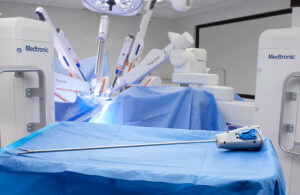
The agency’s clearance covers the first version of the LigaSure Maryland jaw device designed specifically for robotic-assisted surgery. According to Medtronic, the hand-held vessel sealer has previously been used in more than 45 million procedures worldwide.
“Vessel sealing sits at the center of how surgeons work through the most demanding moments of a procedure, and surgeons have trusted LigaSure to do it across open and laparoscopic surgery for decades,” Dr. Matthew Kroh, chief medical officer for Medtronic’s surgical business, said in a statement.
The LigaSure RAS Maryland instrument previously picked up a European approval for use with the Hugo system through a 2025 CE mark. It connects with the Valleylab FT10 energy platform housed in the robot’s tower, with curved jaws to seal and cut vessels, thick tissue and lymphatic channels as large as 7 mm in diameter.
In the U.S., the modular Hugo robot obtained its first FDA clearance within urologic surgery in December 2025. Medtronic plans to expand its use across soft-tissue procedures, including gynecologic and general surgery, and it previously posted positive clinical results in inguinal and ventral hernia repair.
In February the company reported the system completed its first stateside commercial cases at the Cleveland Clinic. Earlier this month, Medtronic CEO Geoff Martha said he expects Hugo to pass the 50,000-procedure mark by the end of the company’s fiscal year, which runs through next April.
At the same time, the company has made a major investment in robotic surgery with $700 million to back Cornerstone Robotics and its Sentire system, plus a deal to distribute the platform in certain markets outside the U.S.
Medtronic said it sees the multi-port, endoscopic Sentire as complementary to Hugo. Hong Kong–based Cornerstone received a CE Mark in May and the system has also been approved in China and Singapore.