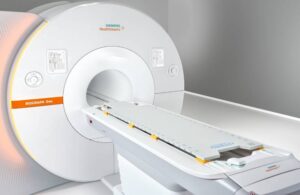
The PET/MR (positron emission tomography/magnetic resonance) scanner enables simultaneous visualization of organ location, function and cellular metabolism. The company says PET/MR can potentially reveal a tumor’s location and its metabolic activity and response to treatment. With these capabilities, Biograph One can deliver enhancements in theranostics for personalized oncology treatments.
Siemens Healthineers said in a news release that studies also suggest that PET/MR could become a tool for neurodegenerative diseases. The company said emerging drug therapies for diseases like Alzheimer’s rely on PET scans to confirm a diagnosis, while MR scans monitor related side effects.
Biograph One builds on the company’s first PET/MR system, Biograph mMR, which it introduced in 2011. Siemens Healthineers said the second-generation system enables faster image acquisition times and more efficient workflows than previous generations of PET/MR scanners.
The new system seamlessly integrates PET and MR to reduce operational complications associated with other such scanners. Siemens Healthineers said the system offers more efficient workflows while reducing patient scan times by 50%.
Siemens plans to deconsolidate Siemens Healthineers through a spin-off. Read more about the company’s future here.
More features of the new Siemens Healthineers PET/MR system
Siemens Healthineers based its MR technology on its Magnetom Vida 3 Tesla scanner. It based its digital PET detector with lutetium oxyorthosilicate (LSO) crystals on the high-end Biograph Vision PET/CT scanner. The company said its system’s spatial resolution and time-of-flight could increase system sensitivity for faster exams and flexible dose administration.
According to the company, many PET/MR scans constitute whole-body exams, which often exceed 60 minutes. Biograph One has a 35 cm axial field of vision digital PET detector, ideal for scanning large-body regions. The large PET detector reduces acquisition time for whole-body images by requiring fewer bed positions, too.
Siemens Healthineers said the scan times come in at less than 30 minutes to fit more typical radiology schedules and support twice as many patients.
The platform also incorporates several AI technologies. The MyExam Companion intuitive user interface provides radiologic technologists with advanced automation features. This simplifies the entire scanning workflow, the company said.
Deep Resolve Boost 2D and 3D image reconstruction accelerates image acquisition and removes noise and improves image sharpness. The company also touts new, flexible BioMatrix Contour XL MR coils that provide effecitve whole-body patient coverage using fewer coils. This reduces setup time and technologist exposure to radiation. Additionally, n integrated BioMatrix Position Sensor communicates with the system to suggest optimal patient positioning, potentially reducing exam setup time.
“Over the past few years, we have seen a fundamental shift in personalized medicine. This shift has been driven by new drug developments, theranostics, and advances in technology, accompanied by a surge in the diagnosis of cancer and neurological diseases, especially Alzheimer’s disease,” said Katie Grant, head of Magnetic Resonance at Siemens Healthineers North America. “Patients experience a long, arduous pathway to answers and treatment. The Biograph One is the culmination of over a decade of experience in harnessing the diagnostic power of these two imaging worlds into one single modality, resulting in one truly patient-centric pathway for every single patient.”