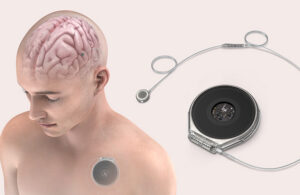
This year Paradromics completed the first implantation of its Connexus BCI in a feasibility study, and then demonstrated that the patient could use the device to choose her own words and answer open-ended questions in real time.
The accurate placement of the system’s electrodes — with more than 400 densely packed into a module smaller than a dime — relied on functional MRI scans of the woman’s cortex. Following a diagnosis of a motor neuron disease that resulted in severely slurred speech, the images highlighted a specific subregion that lit up during language-based tasks.
MRI data is also used to map the structure of and topography of the cerebral cortex, where degenerative conditions can lead to thinning where the implant rests upon the brain’s surface.
With Siemens Healthineers, Paradromics hopes to develop imaging protocols that will span the entire implantation process — from candidacy assessment and neural target identification to surgical planning, navigation and validation — employing MRI, CT and vascular scans.
“Brain-computer interfaces represent an important new frontier for neuroscience,” Siemens Healthineers’ magnetic resonance head, Dr. Donald Hardie, said in a statement. “Working with Paradromics gives us the opportunity to explore how advanced multimodal imaging, automation and clinical decision support can help make these procedures more precise, repeatable and ultimately more accessible across leading medical centers.”
The goal of one day reaching as many patients as possible also shaped the design of the implant itself, which incorporates the same materials and approaches used for decades in devices such as deep brain stimulators and pacemakers.
Related: How Paradromics designed its Connexus brain-computer interface system
Connexus’ cortical module is placed through a craniotomy, and is connected by leads to a larger control unit under the skin of the chest. With no wires through the skin, Paradromics aims to avoid the risk of infections, with a targeted device lifetime of at least a decade.
“Our approach has always been to build the Connexus BCI platform into the existing healthcare ecosystem, working with leaders across the care pathway and using established technologies and clinical workflows wherever they make sense,” said Dr. William Marks, Paradromics’ chief clinical officer. “We want to make things easy for hospitals, not require them to buy and train on bespoke capital equipment.”
Earlier this month, the company said that its devices implanted in two sheep have been well tolerated while delivering four years of stable neural recordings. Paradromics’ human feasibility study aims to enroll up to 10 participants.
“The ability to understand each patient’s individual anatomy and functional organization can help us identify the right neural target and place our technology with greater accuracy,” said Paradromics CEO Matt Angle. “Working with Siemens Healthineers will help us streamline this process prior to surgery, so that patients get the best possible outcome.”
The two companies will also compare functional MRI predictions with neural activity recorded from Connexus, to help researchers confirm how accurately personalized imaging can identify important brain regions for future patients.