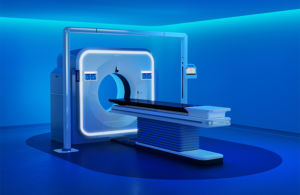
The Rembra platform includes the Rembra CT, Rembra RT and Areta RT systems. Philips unveiled Rembra CT, its next-generation radiology computed tomography (CT) imaging system, last month. It debuted Rembra RT and Areta RT in September 2025 as well, in addition to what it labels the world’s first detector-based spectral CT fully powered by AI, unveiled in December 2025.
Amsterdam-based Philips said it designed its newly cleared systems to help healthcare providers respond to the growing demand for imaging and radiation therapy planning. They help improve speed, efficiency and access to high-quality imaging.
Philips says Rembra extends the role of computed tomography (CT) across both diagnostic radiology and radiation therapy. It helps to enable more connected workflows and a coordinated approach to patient care.
Rembra CT features a largest-in-class 85-cm bore, built for the front lines of care. The company says it enables ultra-fast, high-throughput imaging, supporting up to 270 exams per day. Its use spans various settings, including emergency departments, critical care and interventional settings.
Philips said Rembra RT and Areta RT bring these advantages into radiation therapy as well. These systems support high-fidelity imaging for treatment planning. They feature a wide, 85-cm extended field of view and next-generation 4DCT imaging capabilities.
Altogether, the company says its platform offers a unified, high-performance CT ecosystem that spans the full care continuum.
Dan Xu, business leader of CT at Philips, said:
“As healthcare systems manage increasing demand and complexity, imaging plays a critical role in enabling timely and informed clinical decisions. With the Rembra platform, we are redefining what clinicians can expect from CT, combining speed, scalability, and precision to expand access to high-quality imaging while supporting confident diagnosis and highly accurate treatment planning.”