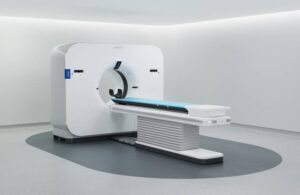
The system, called Verida, aims to transform CT imaging, using AI to optimize the entire imaging chain. Amsterdam-based Philips says it lowers system noise, elevates image quality and accelerates the clinical workflow.
Philips’ spectral CT uses PACS-native delivery and fully embeds into clinical workflow. Spectral CT measures how tissues absorb different X-ray levels, with detector-based spectral CT capable of delivering multiple spectral results from a single scan with no tradeoffs in performance or scan time.
Verida now integrates AI across the imaging chain, from acquisition to reconstruction. It generates industry-leading, superior spectral image quality with minimal noise, in addition to high-definition conventional images. With full AI capabilities, the system can achieve dramatic dose reduction without compromising image quality and reduce energy consumption by up to 45%.
Philips says Verida reconstructs 145 images per second, delivering entire exams automatically in less than 30 seconds. That represents twice the speed of previous offerings, enabling up to 270 exams every day. It builds on Philips’ proprietary Spectral Precise Imaging technology, using deep learning AI with advanced imaging. Using third-generation Nano-panel Precise dual-layer detector technology, Verida delivers faster, more dose-efficient reconstructions.
The company plans to make Verida available in 2026.
Dan Xu, business leader of CT at Philips, says Verida sets a new standard in “superior image quality and accelerated scans.”
“While photon-counting CT adds complexity, is yet to move from the research arena into clinical practice, Philips spectral CT has been a clinical workhorse for more than a decade and delivers comparable or better clinical outcomes, standing up to the most demanding throughput and at significantly lower total cost of ownership,” Xu said.
Philips also expands the availability of AI-enabled light-based 3D navigation
In addition to the Verida unveiling, Philips — one of the world’s largest medical device companies — expanded the commercial availability of its LumiGuide 3D Device Guidance in the U.S. and Europe.
The company touts LumiGuide 3D as the world’s first real-time, AI-enabled, light-based 3D navigation solution for image-guided therapy. It marks a step forward in radiation-free navigation, allowing physicians to visualize and guide devices inside the body using light.
LumiGuide seamlessly integrates with Philips’ Azurion image-guided therapy platform to drive procedural innovation, the company says. It joins a suite of intelligent, AI-enabled, supportive and therapeutic devices integrated on Azurion.
Philips said it plans to make LumiGuide commercially available in January 2026. The system was first made available through a limited market release since the end of 2023.

