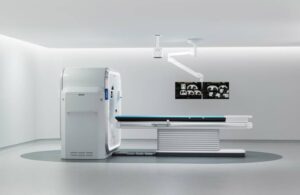
The Dutch medtech giant designed Rembra for the realities of acute and high-demand imaging, according to a news release. It plans to debut the new CT system at ECR 2026 in Vienna.
Philips said it engineered Rembra to meet the challenges of increasing patient volumes and clinical complexity alongside workforce shortages. It features advanced detector technology, ultras-fast scan and reconstruction speeds and streamlined workflows. The company built the system for speed, consistency and long-term value.
“Rembra is built for the realities that clinicians face every day,” said Dan Xu, Business Leader for Computed Tomography at Philips. “By combining our most advanced detector technology with AI-powered workflows and industry-leading speed, Rembra represents a significant step forward for high-acuity imaging, delivering speed, access and diagnostic confidence when it matters most.”
More about the Philips Rembra system
Philips said that Rembra addresses the challenges of delays in image reconstruction. Those include delayed diagnosis in emergency, trauma and other high-demand settings. It offers speed in these scenarios, delivering up to 106 images per second. This can also support smoother workflows and timely clinical decisions in emergency departments.
Altogether, Rembra can support 270 exams per day, helping imaging departments manage growing volumes. Philips labels its 85-cm bore as the largest in class, helping to facilitate patient access and positioning. This also could improve comfort for trauma, bariatric and interventional cases.
Rembra features a 60 cm standard field of view (sFOV) and an 85 cm extended field of view (eFOV). Both are the largest in their class for frontline radiology CT systems, Philips said, alongside a high-performance patient table with a scan range of up to 2.3 meters and a gantry-to-tablespace of 46 cm to support flexible positioning.
Philips said the heart of Rembra includes its newest NanoPanel Precise XD high-density detector. It uses AI to deliver high dose-efficiency, high-resolution imaging at the source. The detector has in-plane spatial resolution of 23 line pairs per cm and a 2D nati-scatter grid.
Rembra integrates AI-enabled smart workflows to help automate routine steps and simplify certain operations as well to support efficiencies.
Another CT debut
Philips also said it’s also delivering the European debut for Verida at ECR 2026, showcasing its first detector-based spectral CT powered by AI. The company introduced what it calls the world’s first detector-based spectral CT fully powered by AI in December 2025.
Verida integrates AI across the entire imaging chain. Philips says it lowers system noise, elevates image quality and accelerates the clinical workflow.
The spectral CT uses PACS-native delivery and fully embeds into clinical workflow. Spectral CT measures how tissues absorb different X-ray levels, with detector-based spectral CT capable of delivering multiple spectral results from a single scan with no tradeoffs in performance or scan time.
Verida now integrates AI across the imaging chain, from acquisition to reconstruction. It generates industry-leading, superior spectral image quality with minimal noise, in addition to high-definition conventional images. With full AI capabilities, the system can achieve dramatic dose reduction without compromising image quality and reduce energy consumption by up to 45%.