The companies did not disclose the financial details of their agreement.
SpectraWave develops EVI technologies and offers angiography-based physiology solutions while seeking to advance AI in medical imaging. Philips — one of the world’s largest medical device companies — said the company’s solutions provide advanced offerings for the treatment of patients with coronary artery disease (CAD).
Bedford, Massachusetts–based SpectraWave — founded in 2017 — currently employs more than 70 people.
The acquisition aims to add to Philips’ existing portfolio of image-guided therapy offerings and AI-enabled technologies. It expects to continue to grow its intravascular imaging portfolio, centered around its Azurion image-guided therapy platform.
“Our global leadership in image-guided therapy is driven by deep clinical collaboration combined with our latest technology insights across hardware, software and AI, to innovate interventional procedures for better and more patient impact. Our world-class portfolio integrates interventional systems and devices into one platform, Azurion, serving patients worldwide,” said Philips CEO Roy Jakobs. “We are doubling down on image-guided therapy and expanding our portfolio in the coronary intervention segment with the addition of SpectraWave’s AI-powered innovations in high-definition intravascular imaging and angio-based physiological assessment, enabling us to deliver better care for more people.”
More about SpectraWave and its acquisition by Philips
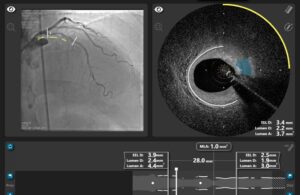
SpectraWave’s HyperVue imaging system combines next-generation DeepOCT images and near-infrared spectroscopy (NIRS) with workflows optimized for the cath lab. It serves as a central hub for future enhancements to enhance interventionalists’ treatment decision-making and optimization.
The technology optimizes image quality and procedural efficiency with no-flush catheter prep and fast and long pullbacks. These reduce and remove the use of contrast. Additionally, it features a comprehensive AI-driven workflow and image analysis offering.
Philips expects to combine HyperVue with its Eagle Eye Platinum digital IVUS and IntraSight technologies.
SpectraWave also offers the X1-FFR angiography-derived, AI-enabled physiology solution. It calculates Fractional Flow Reserve (FFR) from a single coronary angiogram to provide a non-invasive ischemia assessment. That turns routine X-ray images into coronary physiology data for simplified percutaneous coronary intervention workflows.
Philips said X1-FFR complements its OmniWire iFR technology by extending physiologic guidance to wire-free scenarios. It equips clinicians with versatile tools to widen the adoption of coronary physiology in daily practice.
“Philips shares our deep conviction that the convergence of intravascular imaging, coronary physiology and AI can fundamentally improve how every patient with coronary disease is treated,” said Eman Namati, CEO of SpectraWave. “This partnership allows us to integrate and scale HyperVue and X1-FFR into the world’s leading image-guided therapy ecosystem, expanding choice for clinicians and supporting more consistent, high-quality care for the millions of patients who depend on coronary intervention each year.”