Medical Microinstruments (MMI) has commercially launched its Robotic Suture in the U.S. The robotic suture is the first suture purpose-built for MMI’s Symani surgical system, the company said in a news release.
“The introduction of advanced technology, such as robotics, is driving continued demand for innovation in microsurgery,” he said. “The suture expands that ecosystem with a solution that further supports surgeons and their patients with enhanced precision, efficiency, and outcomes.”
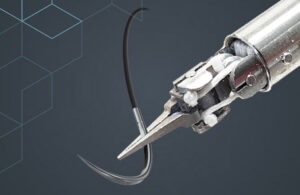
Robotic Suture features a shorter suture length and needle enhancements tailored to robotic techniques. It’s designed to improve handling, streamline workflow and provide consistent performance during robotic anastomosis, or the surgical connection between two body structures such as blood vessels or intestines.
MMI designed the suture to go beyond traditional suture capabilities. It’s approximately one-third to one-half the length of conventional micro sutures, a design feature to improve manageability and decrease anastomosis time during complex procedures. Direct surgeon loading streamlines workflow with easy grasping in supermicrosurgery cases.
(Learn more about the surgical robotics space in our MassDevice Surgical Robotics Special Report. Download the report for free here.)
The robotic suture includes two needle curvature options to ensure optimal needle angulation with the potential to improve patency and minimize tissue trauma, the company said. It comes in a full size range of 8-0 to 12-0 to support all microsurgical and supermicrosurgical applications.
MMI developed the suture in partnership with Japanese medical device manufacturer Kono Seisakusho Co., Ltd. (Crownjun), which specializes in microsurgical sutures.
“Our role has always been to advance surgery by solving needs at the smallest scale,” Kono Seisakusho Co., Ltd. President Junichi Kono said. “For years, we have developed microsurgical sutures by listening closely to surgeons and turning highly specialized demands into practical innovation. Together with MMI, we have applied that same philosophy to robotic microsurgery, creating a suture solution that supports greater precision, control, and consistency in demanding procedures.”
Related: 10 surgical robotics companies you need to know
Section Chief of Reconstructive Oncology at Yale New Haven Hospital Dr. Siba Haykal was the first surgeon to use the new suture in clinical cases.
“Standard suture needles often have a long curve not ideal for robotic work. Based upon my early experience in supermicrosurgical procedures, the Robotic Suture has better positioning with a curvature that suits the instrument design, making needle passage easier with limited wrist articulation required,” Dr. Haykal said. “The shorter length is key for the robot and for smaller vessels, and these features could help me reduce my overall suture usage. I also see myself using the suture in my manual cases.”
MMI aims to broaden its surgical reach, accelerate adoption of its Symani platform with the commercialization of the robot-specific suture and grow in the micro suture global market (8-0 and smaller) estimated at $446 million, the company said. MMI’s robotic microsurgical suture is now commercially available in the U.S., with plans to expand into additional markets in the future.