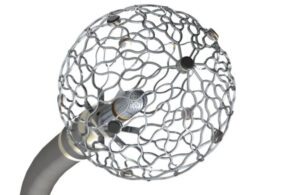
The medtech giant said the FDA granted breakthrough device designation for its Sphere-9 catheter for the treatment of ventricular tachycardia (VT). At Heart Rhythm Society (HRS) 2026 in Chicago, the company also presented new data supporting the use of Sphere-9 for VT, in addition to new findings for the Sphere-360 system.
Medtronic’s Affera mapping and ablation platform makes up a key component of Medtronic’s PulseSelect pulsed field ablation (PFA) system. It became the first such system FDA-cleared for treating AFib in 2024. Medtronic brought in these technologies through its $1 billion acquisition of Affera in August 2022.
The company’s Sphere-9 is a catheter system that uses a nitinol cage to deliver both radiofrequency (RF) and pulsed field (PF) energy for ablation. Its 9 mm lattice tip is smaller than the Sphere-360 single-shot PFA catheter, which has an expandable diameter of up to 34 mm. For pulmonary vein isolation, the smaller Sphere-9 catheter can deliver more targeted, focal energy versus single-shot ablation (from the Sphere-360 or PulseSelect catheters) that delivers energy around the entirety of the pulmonary vein without the cardiologist having to rotate the catheter.
More from Medtronic at HRS 2026: New data backing Aurora EV-ICD, OmniaSecure
Results from the ongoing early feasibility study evaluating Affera and Sphere-9 for VT after heart attack included patients followed out to six months post-ablation. Findings included 65% freedom from VT recurrence at six months.
Sphere-9 has approval in the U.S., Europe, Australia and Japan for certain indications, but not for VT in any geography. Sphere-360 received CE mark in January, when Medtronic also completed the. first cases in a U.S. IDE study for the catheter.
Medtronic says the latest advances for its Affera technologies support its continued investment to bring it to potential new indications.
Also at HRS, Medtronic shared a new sub-analysis from its Sphere-360 European study. This demonstrated positive results related to durability of lesions in AFib procedures in patients with left common pulmonary veins.
Findings included 100% lesion durability, highlighting consistency across varying anatomies. Previously reported durability data showed 98% per vein and 93% per patient durability through invasive remapping at 75 days post-ablation.
Medtronic also announced the first patient enrolled in Conquer-AF, another Sphere-9 study. This prospective, multi-center, interventional, non-randomized study aims to evaluate the safety and effectiveness of Sphere-9 in patients with recurrent paroxysmal or persistent AFib who previously underwent an ablation procedure. The company has ongoing enrollment in the U.S., Europe and Australia.
Commentary from Medtronic officials and investigators
Dr. Khaldoun, Tarakji, VP, chief medical officer, Cardiac Ablation Solutions at Medtronic, said:
“Our robust clinical research program reinforces our commitment to advancing safe, effective, and efficient therapies to help physicians treat a wide range of cardiac arrhythmias and improve patients’ lives. The encouraging results shown in this VT study underscore the versatility of the Sphere-9 catheter in treating a variety of different arrhythmias and the potential to advance care and outcomes for patients whose disease is often complex. With the Sphere-360 catheter, consistent durability across a wide range of patient anatomies is good news for patients and for physicians’ workflow.”
Dr. Vivek Reddy, director of cardiac arrhythmia services for the Mount Sinai Health System in New York City, said:
“Physicians urgently need better tools for VT that are safe, effective, and increase procedure efficiency, so it’s exciting to see sustained outcomes for ischemic patients treated with the Affera mapping and ablation system and the Sphere-9 catheter after six months. Moving this research forward to the IDE trial and expanding the patient population to include non-ischemic patients are positive next steps for VT patients.”