The medtech giant shared its findings at Heart Rhythm Society (HRS) 2026 in Chicago. Results build on findings shared from two studies at the Asia Pacific Heart Rhythm Society (APHRS) Scientific Session 2025 last fall that backed both technologies.
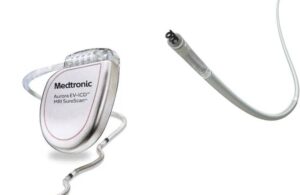
Medtronic’s Aurora extravascular implantable cardioverter defibrillator (EV-ICD) provides the life-saving benefits of traditional ICDs with a lead placed under the sternum. It features Smart Sense technology that reduces oversensing, a common reason for inappropriate shocks. Medtronic won FDA approval for the system in 2023.
The OmniaSecure defibrillation lead connects to an implantable defibrillator. It can treat potentially life-threatening ventricular tachyarrhythmias, ventricular fibrillation (VT/VF) and bradyarrhythmias. Medtronic labels it the world’s smallest defibrillation lead, coming in at 4.7 Fr, or 1.6 mm. That equals about the diameter of graphite in a wooden pencil. The defibrillator lead won FDA approval for right ventricle placement in April 2025 and launched at the start of this year. It then picked up expanded FDA approval for conduction pacing last month.
“Having both extravascular and transvenous defibrillation solutions allows physicians to meet patients where they are, providing different options that address patients’ individual needs, which can vary widely,” said Trevor Cook, VP and GM, Defibrillation Solutions at Medtronic.
More on the Medtronic Aurora EV-ICD study
At HRS, researchers presented late-breaking results from the Enlighten study, the EV-ICD post-approval registry. Findings demonstrated “excellent outcomes” at 12 months.
The first-of-its-kind system showed high anti-tachycardia pacing (ATP) success and effective defibrillation. It also offered a low rate of chronic, system-related major complications and an improved inappropriate shock rate in a real-world setting.
Medtronic says the system is the only defibrillator with a lead positioned outside the vasculature that delivers ATP therapy and other benefits of a transvenous ICD. It has a similar size, shape and longevity compared to traditional systems while delivering new benefits.
The company says in its latest one-year outcomes from 787 patients, ATP successfully avoided 65 shocks in 22 patients. ATP also delivered a high termination rate (74.2%) in line with transvenous ICDs and the Aurora pivotal trial.
Investigators reported strong safety results, with 95.8% of patients free from a chronic major system-related complication through one year. They effectively treated 100% of spontaneous potentially lethal VT/VF episodes. Medtronic also reported that the. rate of inappropriate shock went down by 30% compared to the pre-market trial.
“We are seeing Aurora EV-ICD continue to perform as well in real-world settings as it did in the clinical trial, if not better in some areas,” said Dr. Lucas V.A. Boersmacardiologist at St. Antonius Hospital, Department of Cardiology, Nieuwegein, the Netherlands and professor of cardiology, Academic Medical Center (AMC), University of Amsterdam, the Netherlands, who presented the Enlighten data at the meeting. “These longer-term outcomes demonstrate consistently strong performance across age groups. Based on the growing body of evidence, the Aurora EV-ICD should be a first-line consideration for patients who haven’t had a prior sternotomy and don’t require pacing but can benefit from a defibrillator.”
New data for OmniaSecure
Medtronic also shared findings from the global LEADR LBBAP (left bundle branch area pacing) study. The company said outcomes reinforced OmniaSecure’s strong safety and efficacy profile in the LBBA.
Investigators reported high defibrillation success at implant (100%) regardless of coil position in the right ventricle (RV). The study also saw a low rate of OmniaSecure-related major complications (3.2%) at 12 months and stable electrical performance in all patients.
Results also included improved heart function and measurable improvements in patients’ quality of life at six months in those receiving LBBA-optimized cardiac resynchronization (LOT-CRT). This novel therapy combines CSP with left-ventricular pacing.
“With the recent launch of the OmniaSecure defibrillation lead, patients who require chronic pacing therapy and defibrillation now have access to a lead built for reliability that can safely and effectively restore the heart’s natural physiology through conduction system pacing,” Cook said.