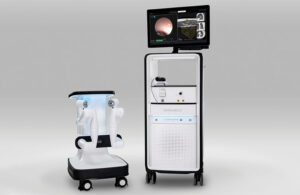
Johnson & Johnson MedTech (NYSE: JNJ) today announced the launch of Monarch Quest 3, the latest software iteration for its Monarch robotically assisted bronchoscopy platform.
This update, which comes after FDA 510(k) clearance, is the fourth launch that the company has rolled out for the platform in 18 months.
The Monarch platform aims to provide clinicians with continuous visualization, precise, stable control and targeting assistance as they navigate to and biopsy targets within the lungs.
With its new enhancements, Monarch Quest 3 improves on registration and introduces a new 3D compass overlay, simplifying scope-tip orientation and giving clinicians more control and clarity as patient anatomy shifts, according to Johnson & Johnson MedTech.
It delivers AI-powered nodule segmentation, with a goal of generating more accurate boundaries during pre-procedural planning.
Monarch Quest 3 also offers greater compatibility with commonly used mobile and fixed Cone-Beam CT (CBCT) imaging infrastructures to counteract CT-to-body divergence, in which a patient’s pre-operative imaging doesn’t match their real-time anatomy during a procedure.
“This release reflects our ongoing commitment to innovation in robotically‑assisted bronchoscopy,” Dr. Gaetane Michaud, interventional pulmonologist and senior director of medical affairs at Johnson & Johnson MedTech, said in a news release. “Monarch Quest 3 builds on a series of advancements introduced over the past several years, all focused on helping clinicians navigate with greater confidence and target lung nodules with accuracy.”
Gaining regulatory clearance for Monarch Quest 3 marks another step to advancing the platform’s ability to improve outcomes for lung cancer patients.
“Our work doesn’t stop at clearance,” said Aleksandra Popovic, president of March at Johnson & Johnson Medtech. “Monarch Quest 3 is another step in a deliberate, ongoing innovation roadmap designed to help clinicians diagnose lung cancer earlier and more confidently, and to continue raising the standard of care.”
Johnson & Johnson first acquired the Monarch platform in 2019 through its $3.4 billion purchase of surgical robotic pioneer Dr. Fred Moll’s Auris Health. Monarch won its first FDA clearance in 2018.
“Being first to market carries a responsibility to keep advancing,” Popovic said. “With Monarch Quest 3, we’re continuing to evolve the Monarch platform in close partnership with clinicians, applying artificial intelligence, expanding imaging integration, and delivering software enhancements that support greater procedural confidence and precision for patients.”
Competition has been increasing for Johnson & Johnson MedTech in the space.
Last week, Noah Medical announced the launch of its Galaxy II software, strengthening its Galaxy system’s Dual-Mode imaging, which allows clinicians to switch between high-definition digital tomosynthesis (HD-DT) and CBCT at any point during a robotic-assisted bronchoscopy, reducing overall exposure to radiation.
In October of 2025, Intuitive won clearance for software advancements within its Ion platform, introducing system-wide AI. The company attributed a 51% increase in procedure use to the 2025 rollout.