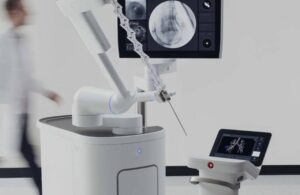
Intuitive Surgical (Nasdaq: ISRG) announced today that it received FDA clearance for new software advancements for its Ion endoluminal robot.
The Ion robotic bronchoscopy system — which the FDA cleared in 2019 — is a robotic-assisted, catheter-based platform. Ion enables minimally invasive biopsy deep within the lung. Fiber optic shape sensor technology along the catheter’s length provides its precise location and shape information throughout the procedure.
Ion’s ultra-thin, shape-sensing catheter can navigate deep into the lung to access small, hard-to-reach nodules. It enables physicians to precisely position biopsy tools and sample potentially cancerous tissue.
The latest software release introduces AI across Ion’s entire navigational workflow. It also integrates new advanced imaging capabilities to support accurate, efficient lung biopsies.
Intuitive’s Brian Miller will sit on a DeviceTalks West panel exploring how the industry is preparing for the potential — and the problems — of telesurgery. Iman Jeddi, SVP and GM of Single Port Surgery, will sit down for the event’s closing keynote interview to discuss Intuitive’s strategy for da Vinci 5. Check these discussions out at DeviceTalks West, Oct. 15–16, 2025 in Santa Clara, California. Register now at West.DeviceTalks.com. Use the discount code MD25OFF for 25% off.
Intuitive’s latest software updates come about a month after it added new surgical insights for its leading da Vinci platform as well.
“These latest Ion software advancements reflect Intuitive’s ongoing commitment to advancing lung cancer care through meaningful innovation,” said Intuitive CEO Dave Rosa. “By further integrating artificial intelligence with expanded advanced imaging capabilities, we’re equipping physicians with smarter tools designed to support early diagnosis and improve access to advanced care for more patients.”
More about the AI enhancements for the Intuitive Ion platform
Sunnyvale, California-based Intuitive says Ion’s latest AI-powered navigation builds on its existing strengths. It aims to address CT-to-body divergence, a key challenge in lung biopsy. This occurs when a long nodule sits in a different location during the procedure relative to the pre-procedure CT scan due to lung movement. The shift cna make it more difficult to reach the target accurately.
Ion now uses AI to correct this in real-time, combining computer vision with its shape-sensing technology. This feature compares live images to the original plan, adjusting the view along the navigation path as needed. The company says this increases workflow efficiency, reduces manual steps and improves accuracy while inspiring physician confidence.
Intuitive also introduced new, improved advanced imaging capabilities, including integrated tomosynthesis. This innovation enables real-time imaging updates with a standard 2D C-arm, allowing physicians to tailor workflows to each patient’s needs.
The company plans to roll out the new features through a limited launch, enabling it to gather performance insights. It then plans for a broader launch in 2026.
“We know that early diagnosis can make a life-changing difference for patients with lung cancer,” said Federico Barbagli, SVP and GM, Endoluminal at Intuitive. “That’s why we continue to relentlessly innovate—advancing Ion’s capabilities to support more efficient, accurate, and personalized procedures across a wide range of healthcare environments. We’re committed to equipping care teams with the tools they need to deliver timely answers for patients and improve outcomes where it matters most.”
As of June 30, 2025, Intuitive reports more than 900 Ion systems in place in hospitals across 10 countries. It continues to add to the platform with these latest enhancements.
Read also: