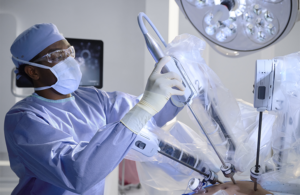
The medtech giant announced FDA de novo authorization for Ottava on Wednesday, marking the first regulatory nod for the robot, which makes it the first table-integrated soft-tissue robotics system given the FDA’s green light.
Ottava is the latest of a few long-awaited entries to the surgical robotic market, including Medtronic’s Hugo, which earned its first FDA nod for urologic procedures in December 2025.
J&J initially unveiled Ottava in 2020 as a potential minimally invasive surgical robotic option to rival longtime soft-tissue robotics leader Intuitive Surgical. After some development timeline delays raised questions about the platform, the approval finally allows the company to bring Ottava to the U.S. market, initially for a range of general surgery procedures.
“This is an incredible moment for our organization, not only for the Ottava team, many of our team members have been on this journey for a while, but most importantly for the whole Johnson and Johnson organization,” Rocco De Bernardis, global president, Ottava, told MassDevice in an interview. “We’ve been leading surgery for 140 years. We were born in surgery. For us, Ottava is an opportunity to restate our leadership in surgery and bring it into the future.”
More on Medical Design & Outsourcing: A first look at J&J’s Ottava surgical robotics system
The journey to this point
After the initial unveiling, the company remained quiet about Ottava before it pushed back the platform’s development timeline by about two years due to multiple factors in late 2021.
Once on track, though, the company announced that it submitted Ottava for FDA investigational device exemption (IDE) in October 2024. Less than a month later, the FDA approved that IDE, allowing the company to kick off a bariatric surgery study.
J&J submitted the robot to the FDA for de novo approval in January. In May, the company said Ottava met its endpoints in a pivotal study. Finally, on July 22, the long-awaited authorization arrived.
“When you are trying to do something so disruptive and so innovative, innovation is not a straight line,” De Bernardis said. “We had to navigate that.”
De Bernardis said J&J wanted to address the key challenges of surgical robotics by driving better visibility, communication, workflows and efficiency.
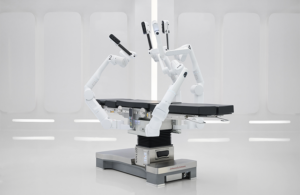
Doing all of this in a smaller surgical robot that integrates its arms into the surgical table was the biggest hurdle to clear.
“This is a complex engineering problem that we had to solve for,” he explained. “Our intent was to take on a complex engineering problem to bring simplicity back to surgeon and surgical teams. … That was not an easy problem to solve and I couldn’t be prouder of our R&D teams and our innovators that were able to develop on such a challenge.”
Where Ottava fits in within the surgical robotics space
Ottava’s de novo authorization highlights that there is no predicate on the market. While the first table-integrated soft-tissue robot will compete against the other platforms, like da Vinci and Hugo, it brings a different option to surgeons.
“We couldn’t be more excited about what we’re bringing to market today,” De Bernardis said. “It’s indisputably something that is very differentiated versus what exists today, and we can be more confident that that’s going to help us establish leadership in this space.”
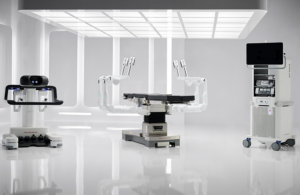
“That means that the robot is a table and the table is a robot,” De Bernardis said. “There are no booms, no carts, which is basically where soft-tissue robotics has been stuck to a certain extent from a design standpoint.”
The technology also connects with the Polyphonic digital ecosystem to support teams throughout the Ottava experience. Polyphonic brings learning, media and data-driven insights together to support continuous improvement across the surgical journey.
Johnson & Johnson wants to build beyond traditional surgical robotics with these digital capabilities, enabling automation and more.
“Automation, from day one, is going to be a main component of how we’re planning to innovate in this space and really remove again some of the manual steps and friction that exist in the operating room,” De Bernardis said.
What’s next for Johnson & Johnson and Ottava
The FDA nod for Ottava covers general procedures such as Roux-en-Y gastric bypass, gastrectomy, cholecystectomy, splenectomy, gastric sleeve, small bowel resection, appendectomy, lysis of adhesions, fundoplication, and hiatal hernia repair.
Johnson & Johnson also currently has a U.S. clinical trial underway for Ottava in inguinal hernia procedures.
“We have, in every indication we’re delivering to the market, areas of innovation and differentiation that surgeons are telling us about,” De Bernardis said. “At the same time, we also understand that it’s important for Ottava to be a multi-specialty robotic system. Ultimately, hospitals are making an investment in our technologies, and they want to make sure that we can drive utilization for them. Being a multi-specialty robotic system is definitely a key part of that.”
J&J plans to commercially launch Ottava with select customers in the U.S. It said it intends to focus on early customer success while working to advance into additional indications and regulatory jurisdictions over time.
“We understand that one of the key things for us to begin with is working with leading, highly reputable institutions in the U.S.,” De Bernardis said. “[We want to] partner with them and make sure that we drive customer success for them, and make them very happy with our technology. They can help us and continue to challenge us on the innovation pipeline that we have designed for the next 3-5 years.”
De Bernardis concluded by calling the milestone a “very special moment” for everyone at J&J and within the Ottava team.
“[Ottava] is something that is definitely going to make an impact in the marketplace, and we cannot wait to work with leading institutions and surgeons that have been working with us for many years to really make an impact and a difference for patients through surgical treatments,” he said.