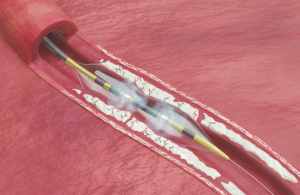
With its $13 billion acquisition of Shockwave Medical in 2024, Johnson & Johnson added the market leader in intravascular lithotripsy (IVL) to its portfolio.
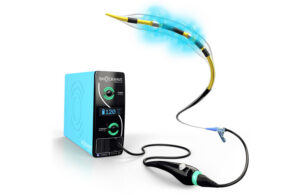
Since then, the company has continued to build on that leadership position with new product rollouts. That includes the recent launch of Shockwave C2 Aero, the latest catheter system for the Shockwave IVL platform. The next-generation catheter leverages Shockwave IVL’s unique mechanism of action and the safety and effectiveness profile of its legacy catheters. It features improved deliverability, enhanced lesion crossing and new repositioning capabilities. The coronary catheter expands the company’s market-leading IVL portfolio for treating calcified coronary artery disease (CAD).
According to Shockwave Chief Medical Officer Dr. Nick West, the company isn’t stopping there.
West explained the key enhancements that come with the Shockwave C2 Aero to MassDevice and outlined the J&J Shockwave unit’s expectations for future improvements to its market-leading IVL platform.
(Read more about the features of the catheter at our sister site, Medical Design & Outsourcing.)
The following has been lightly edited for space and clarity.
MassDevice: Can we get an overview of what C2 Aero is and what went into its design?
Dr. Nick West: “Shockwave C2 Aero is the next-generation IVL catheter. It’s our fifth-generation catheter in the coronary space. We designed this, really, in lockstep with our physician partners. We’d heard from them that, although IVL is a very effective calcium modification therapy, because it’s a balloon-based therapy, you need to be able to get the balloon across the lesion. Given the complex nature of these calcified lesions, sometimes, that was difficult to achieve.
“In order to provide more physicians the ability to treat more of their patients with complex disease, we listened to their feedback, we incorporated it into our R&D process, and we’ve delivered a technology that we think is going to be a game-changer. It’s a significant improvement on our previous offerings.”
What are the improvements with the new Shockwave catheter?

West: “The main drawback of balloon-based IVL is that you need to get a balloon across a lesion when you’ve got very dense calcific deposits or tortuous anatomy. This can be very tricky. We think the improvements that we have made to the catheter have improved it enormously, and the feedback we’ve received already is telling us that in-situ aero allows physicians to to treat these lesions much more easily, providing them greater flexibility during their cases, allowing them to be more efficient and to think about using IVL earlier in their treatment algorithms.”
What was the physician feedback that specifically spurred changes with the catheter?
West: “The target was to develop a catheter with the same predictable safety and efficacy profile as our previous-generation devices, but this time to make it more deliverable to the lesion — make it easier to cross the lesion and make it easier to rewrap the balloon after use, so the device can be moved up and down in the same vessel or even used in another vessel. Those were the main areas for improvement: deliverability, crossability, recrossing and rewrap of the balloon.”
Are there any significant changes in terms of the features of the catheter?
West: “The emitters on our current platform remain the same, so you’re getting the same acoustic output, the same generation of ultrasonic, acoustic pressure waves from the two-emitter design. So, we can leverage all of the safety and efficacy data that we’ve already put out there, and there’s a lot of it. The actual IVL delivery portion of this device is exactly the same, but it’s now encased in a much more user-friendly packaging, which will enable the ability for more physicians to access this therapy, to use it in their complicated cases, and then deliver calcium modifications safely to more patients.”
What differentiates the Shockwave C2 Aero from previous versions?
West: “When you have these very challenging high-grade calcific stenoses, often in tortuous vessels, it can be very difficult to deliver devices to and get them across lesions. The features include a much more flexible shaft with a hydrophilic coating. We have a new balloon material, which enables better deliverability and also better rewrap of the balloon. And, we have flexible marker bands. So all of those features enable enhanced navigation through these heavily calcified, highly stenosed, tortuous vessels.
“We’ve also got a new tapered tip on the catheter, which enables the tip of the catheter to negotiate, enter and glide through to the target treatment site. Of these features … we’ve heard that the rewrap of the balloon has been a major feature to enable physicians to position the device and reposition it. They don’t necessarily have to use other devices to facilitate the crossing of IVL to deliver the therapy. It means that IVL can be moved up, if you like, in the treatment algorithm for these very complex patients and complex lesions.”
What is the rewrap capability?
West: “When you take a balloon out of a packet, it’s wrapped up to make it as small as possible and as crossable as possible with the lowest sort of outer diameter and the lowest crossing profile. [Rewrap is the ability for any balloon] to enable it to cross the tightest and most tricky lesions. The problem is, when you blow a balloon up, it often doesn’t shrink down to the same size that it came in the packet. That’s the phenomenon known as balloon rewrap.”
How does rewrap factor into Shockwave C2 Aero’s performance?
West: “It is fair to say that the earlier generations of the Shockwave IVL platform — because of the nature of the materials that we needed to use to ensure that it was robust and could withstand the ultrasound, acoustic pressure waves, and the treatment of these high grade, very hard and dense, calcific lesions — meant it wasn’t quite as good as rewrapping as other semi-compliant balloons. [These are] your basic angioplasty balloons that are used by physicians. What we’ve done is change the construction of the balloon to make it lower-profile.”
“We’ve enhanced the rewrap. That’s important [because] if a physician positions the balloon over the lesion, treats it, and then wants to move the catheter to a different lesion, the balloon has to rewrap. It has to rewrap well, otherwise you have difficulty navigating that within the coronary artery. That was a possible drawback in some cases with our early devices. We are hearing that with Aero, I wouldn’t say the concern has completely vanished, but it has been hugely enhanced by the new developments we’ve made.”
How did Shockwave manage to build upon an already successful platform?
West: “IVL is an established therapy. We created the IVL space from the beginning. We transformed this concept of using extracorporeal shockwave lithotripsy, used to treat kidney stones, into a miniaturized intravascular version, and that’s set the foundation for the entire space. And we’ve treated a million patients.
“We are the number one advanced calcium modification technology used in both the coronary and the peripheral arterial disease spaces, and we’ve launched nine platforms since 2017. … Our R&D pipeline is not slowing down. We’ve got more than 30 active programs at the present time. C2 Aero is the first through the gate. But you’re going to see many more developments.”
“We’re aiming to address all of the physician and patient needs that we hear. We’re going to be launching at least one new product every year for the foreseeable future. When it came to narrowing down what the drivers were to improve our offering, we simply listened to what physicians were telling us. We don’t want to stand still. We want to create a product that’s not only widely used, but that physicians find easy to use. That’s at the heart of C2 Aero.”

