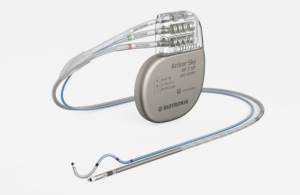
Results from the multi-center CRT-NEXT study demonstrated that CRT-DX is as safe and effective as conventional three-lead CRT-D therapy. The study confirms that most CRT candidates don’t develop the need for atrial pacing in the long term. As a result, they can benefit from therapy with fewer leads.
Dr. Mauro Biffi, the study’s coordinating investigator, presented findings at ACC 2026 in New Orleans. Investigators. also published findings online in Circulation. The findings come nearly six years after Biotronik previously outlined the capabilities of two-lead CRT-D in an earier study.
“These results confirm what early pilot studies suggested: that for the vast majority of CRT candidates, atrial pacing is not needed in the long term,” said Dr. Mauro Biffi, clinical cardiologist and director of Electrophysiology at Sant’Orsola-Malpighi Polyclinic, Bologna, Italy. “By removing the atrial lead, CRT‑DX offers meaningful advantages in safety and procedure simplification—without compromising clinical performance.”
More about the Biotronik study
CRT-NEXT evaluated 636 patients across 23 Italian centers. It marked the latest evaluation to date of CRT-DX therapy, a method that preserves atrial sensing capabilities without requiring an atrial lead.
The study demonstrated three times fewer atrial lead-related complications compared to three-lead CRT-D therapy. Implantation procedures also came in at times 14% shorter than traditional cases, potentially improving workflows.
Investigators reported comparable CRT response rates and functional capacity outcomes. They also saw an extremely rare long-term need for atrial pacing in appropriately selected CRT-DX patients.
Biotronik said that the study reinforces the clinical relevance of CRT-DX technology, making it easier for physicians to adopt the approach.
“Biotronik’s CRT-DX system is the only 2-lead CRT‑D solution on the market,” said Dr. David Hayes, chief medical officer at Biotronik. “The CRT‑NEXT results clearly demonstrate the system’s distinct advantages for both clinicians and patients. This data reinforces our leadership in CRT innovation and offers strong clinical support for a significant evolution in CRT treatment.”