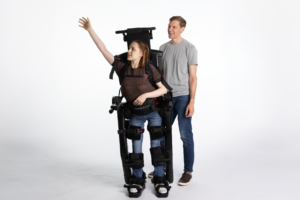
Wandercraft, a Paris-based robotics company, announced that the FDA has granted clearance for Eve, its personal self-balancing exoskeleton designed to support upright mobility.
As long as they can operate Eve’s remote, eligible adults with spinal cord injuries at any level can walk and perform activities of daily living hands-free using self-balancing technology. The device is intended for use on level indoor surfaces and level surfaces in immediately adjacent open-air areas that are part of a building, such as patios and terraces, under the supervision of a specially trained companion.
“FDA clearance of Eve marks one of the most important moments in Wandercraft’s history and a significant step for the people, families, clinicians, researchers and partners who helped make it possible,” Matthieu Masselin, co-founder and CEO of Wandercraft, said in a press release.
“For years, I experienced much of the world while seated,” Caroline Laubach, Wandercraft test pilot, said in a press release. “Using Eve transformed ordinary moments in ways I never expected, like having conversations eye-to-eye whether seated or standing, getting a cup from the highest kitchen cabinet and simply bringing a new type of confidence into my life.”
Wandercraft plans to commercially launch Eve in the United States on Sept. 17 and anticipates that Eve could become eligible for Medicare reimbursement within 60 to 90 days.
Eve will be prescribed by licensed healthcare practitioners. Before use, individuals must complete a clinical assessment, an individualized device fitting and comprehensive training with a companion. Training includes five two-hour sessions that can be completed in as little as one week, the company said in a press release.
Following full commercial launch, Wandercraft has partnered with a growing network of rehabilitation, complex rehabilitation technology (CRT) providers and federal distribution partners, in addition to its walk centers worldwide, to ensure a smooth process from initial evaluation to delivery.
Partners enabling this pathway include:
- Walk US, including its flagship Walk in New York location, specializes in neurorehabilitation using Wandercraft’s Atalante X and will serve as a partner for Eve evaluations, training, demonstrations, community education and preparation for personal use at home. A second location, Walk in Miami by Wandercraft, is expected to open later this year.
- National Seating & Mobility, North America’s largest provider of complex rehabilitation technology, will serve as Wandercraft’s exclusive CRT distribution partner for Eve, leveraging its network of more than 180 locations across the United States and Canada to support evaluation, access, delivery and service.
- Good Shepherd Rehabilitation will serve as the exclusive Eve partner in Pennsylvania’s Lehigh Valley. Eligible users and their companions will be able to learn more about and eventually experience the technology at Good Shepherd’s Hyland Center, with additional access locations expected to open in the future.
- USVetServ, a Service-Disabled Veteran-Owned Small Business, will serve as an authorized independent distributor of Eve and Atalante X for the U.S. Department of Veterans Affairs (VA), its VA Medical Centers and other VA facilities nationwide.
FDA clearance was supported by a three-site clinical trial involving participants with spinal cord injuries and their companions, led by the James J. Peters Department of Veterans Affairs Medical Center in the Bronx, NY, Kessler Foundation in West Orange, NJ and Walk in New York in New York City, NY.
The clinical trial focused on safety, function, training and readiness for personal use. Participants represented a range of injury severities and completed structured training before undergoing functional, usability and task-based assessments designed to reflect intended use in everyday environments.
The clinical program demonstrated that participants and companions could learn to operate Eve and complete activities relevant to personal use. Participants also met key functional and usability endpoints, including measures of walking performance and activities of daily living.
Participants reported improvements in several aspects of daily life, including health status, psychological well-being, endurance during daily activities, lower-limb spasticity and sitting balance. Some also reported improvements in sleep quality and in bladder and bowel function.
While Wandercraft is not the first to market a personal-use exoskeleton, its self-balancing component sets it apart from competitors. Lifeward’s ReWalk and Ekso Bionics’ Indego both rely on crutches for balance and forward propulsion.