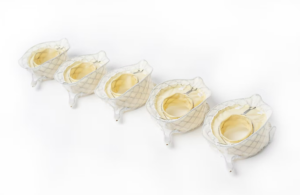
Maple Grove, Minnesota-based VDyne’s TRIVITA study compares the TriNova transcatheter tricuspid valve replacement (TTVR) system head-to-head with the commercially available Edwards Evoque TTVR system to test the valve’s safety and effectiveness in severe tricuspid regurgitation (TR). The company received the FDA’s go-ahead to conduct the study this past spring.
VDyne designed its TTVR system as a patient-tailored, minimally invasive solution to address the complexities of tricuspid valve anatomy and disease.
The company aims for the valve to conform to the patient’s tricuspid anatomy. It features proprietary side-delivery technology to support a wide range of valve sizes, treating more patients in need. Vdyne’s valve has a unique shallow delivery trajectory, plus a self-aligning design to simplify implantation and reduce imaging burden.
According to VDyne, its valve optimizes positioning for full function evaluation prior to valve release. With no hooks or barbs used, it has full repositionability and retrievability. Additionally, the device minimizes structural exclusions. It accommodates low right atrium height, right ventricle structures and previously implanted devices like leads. The company offers it in five sizes as well.
The TRIVITA trial randomizes participants 1:1 to evaluate TriNova against Evoque. It will span up to 70 sites in the U.S. and Europe. Dr. Konstantinos Voudris enrolled the first patient at the Allina Health Minneapolis Heart Institute at Abbott Northwestern Hospital in Minneapolis.
Competition continues to arise in the TTVR space. Beyond the currently available Evoque system, Venus Medtech continues to advance its Cardiovalve TTVR device. TriCares and JensCare also have TTVR options under development, among other potential entrants.
Commentary from VDyne officials and investigators
Mike Buck, Chairman and CEO of VDyne, said:
“Initiating our TRIVITA U.S. IDE pivotal study represents an important milestone for VDyne following years of innovation by our dedicated team. The trial reflects our continued commitment to advancing treatment options for patients with TR and evaluating TriNova’s potential role in the evolving standard of care. As we rapidly activate new investigational sites and build enrollment momentum in TRIVITA, as well as continue enrollment in the ongoing VISTA US & VISTA Global trials, we are moving closer to our ambition of establishing TriNova as the preferred treatment option for TR patients globally.”
Dr. Susheel Kodali, incoming co-director, Heart Valve Center at NYU Langone Medical Center and study chair/global co-principal investigator for TRIVITA, said:
“The benefits and importance of treating TR are quickly evolving as a growing number of patients seek treatment and TriNova represents a significant step forward in TR therapies, an outcome we intend to demonstrate through the U.S. pivotal study. Enrolling the first patient in the US pivotal study brings hope for an improved standard of care. TriNova incorporates next-generation elements designed to offer unique side delivery and compatibility with tricuspid anatomy. The system is designed to operate independently of the leaflets & chordae, ensuring reliable annular anchoring and providing functional evaluation prior to final implantation.”
Dr. Nadira Hamid, director of interventional echocardiography at Minneapolis Heart Institute and scientific director of the Echocardiography Core Laboratory at Minneapolis Heart Institute Foundation and global co-principal investigator, said:
“The start of the U.S. pivotal study represents an important step forward in developing improved treatment options for patients with tricuspid regurgitation. The data from U.S./European/Australian/Canadian early feasibility studies (EFS) and the ongoing VISTA trials have been very encouraging and have provided promising preliminary safety and performance data of TriNova. I am looking forward to this next phase of the TriNova clinical program as we build enrollment momentum in the TRIVITA pivotal trial.”