Speaking on the “Road to a robot: Designing technology to address unmet needs & barriers” panel at DeviceTalks Boston last week, Stow explained that elephants are big, taking up a lot of space and that they eat a lot, making them expensive to maintain.
When customers came to Medtronic about 10 years ago asking them to consider building a surgical robot, the excessive size and price of maintenance applied to those systems, too.
“We looked at the current state of robotics going back 10-plus years, and we realized there was an opportunity for us to come in,” Stow said. “Customers were saying, ‘Hey, could you make something more flexible that fits better into our rooms and into our hospital setting?'”
The third comparison of surgical robots and elephants was slightly different, as Stow said that surgeons described sitting at the console of such a system as “putting their head in the rear end of an elephant.” It was big, it was gray, and while the view was “pretty spectacular,” the surgeons lost all peripheral vision.
“So, about 10 years ago, we set out to build a robot with this belief statement in mind, which is that patients around the world deserve access to quality care, improved outcomes, and we can expand access to that care,” Stow said.
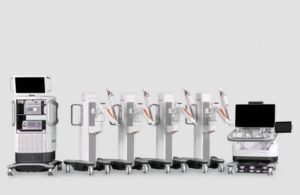
Medtronic’s road to the robot got a kickstart with the 2014 acquisition of Covidien and has culminated, at present, in the Hugo robot-assisted surgery (RAS) system. Hugo received CE mark approval for urologic and gynecologic procedures in October 2021, and the company is working toward getting the system approved in the U.S., too, but can’t share much info as the process is ongoing.
Speaking on the panel with Stow, Medtronic’s Senior Engineering Director of Surgical Robotics Bill Peine explained that, coming over from Covidien, they hadn’t built anything, essentially starting out with a blank piece of paper and trying to pinpoint where to begin.
“We had a very clear definition of what a surgical robot was. But, how do you build one yourself? The way we did it was, we assembled the right team,” Peine explained. “A surgical robot is multidisciplinary. You have to get your architecture right, there’s a lot of mechanical and electrical design, but human factors and the user interfaces are just as critical and important.”
What Medtronic employed to develop Hugo was called the “spiral development” process, starting in the middle and looping around, Peine said.
That entails beginning with nothing and answering big architectural questions upfront, building a quick prototype to evaluate it and putting it in front of customers to get feedback that helps to define particular pieces of the architecture or design. Peine said they then repeated that process “over and over again.”
Medtronic’s spiral development process took about three months per cycle, and the company went through about 13 cycles, Peine said, working for close to three years with thousands of interactions with customers, demos and more.
“Most importantly, the engineering team loved this,” Peine said. “It was so much fun for them because they got to do something quick, and they were participating, getting that market feedback from customers. The R&D team has partnered very closely with the marketing team, so it was fast-paced, and at the end of a cycle, all the different subsystems would integrate their products or their individual parts into the working system.”
Hugo combines wristed instruments, 3D visualization and Medtronic’s cloud-based surgical video capture and management solution, Touch Surgery Enterprise, to offer a multi-quadrant platform designed for a wide range of soft tissue procedures.
Medtronic announced the first urologic and gynecology procedures with Hugo in Latin America and Asia-Pacific over the past year, with the first patient procedure in Chile in June 2021, followed by the first procedure in Europe after winning CE mark in February of this year.
Despite the success of Hugo so far and the potential for U.S. clearance down the line, Peine said that there are parts of the development process that could have been done differently, but it was an enjoyable process that put Hugo in a position to grow.
“Did we get it right? I would say there’s more we could have done. There are things that I definitely would want to go back and change,” Peine said. “But, as an engineer leading innovation in this environment using that spiral development process, it was great, and I think we got to a really good spot.”