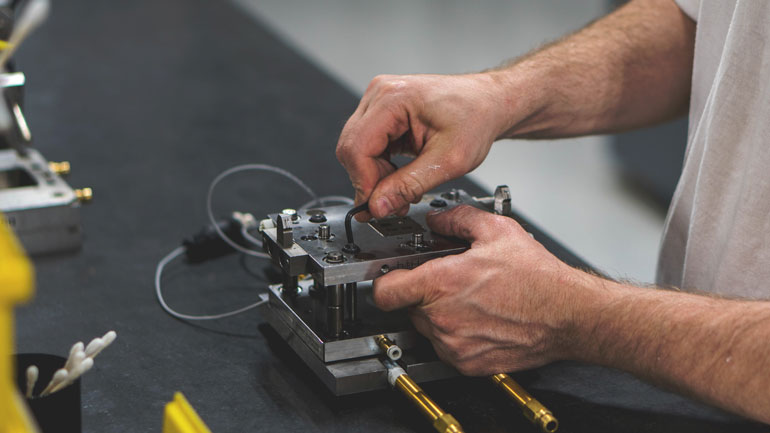
Manufacturing precise miniature plastic parts is the result of exact tooling execution. By understanding the tolerances of both micro tooling and micro injection molding, it’s possible to achieve a high level of repeatability and part accuracy for even the most advanced micro medical devices.
MICRO TOOLING
Equipment Capabilities
The mold is the enabler for manufacturing success, and precise execution is achieved by utilizing state-of-the-art equipment and applying unconventional tooling methods.
Advancements in high-precision mold making and molding technology allow for more possibilities when miniaturizing medical device components. For example, MTD Micro Molding invested in (and customized) equipment for very specialized work:
- Sarix 3D EDM milling machine creates cavity geometry with an end mill electrode that can be as small as 5μ.
- Mitsubishi MX600 oil wire EDM machine lets machining operators use ultra-small wire down to .0008″ (20μ).
Precision & Accuracy
Workpiece accuracy refers to what the actual part looks like coming out of the machine, and not what the machine is specified to do. At MTD, our workpiece accuracy target is 0.000042″ (about 1μ).
Exact Tooling
Achievable features and tolerances in plastic depend on steel accuracy and material. As tolerances become smaller, so does the allowable margin of error for steel accuracy. There is essentially no room for error in micro tooling, but with certain materials, those rules become stricter when tight tolerances are required. With tool inserts moving together like tiny, complex jigsaw puzzle pieces with ultra-precise sequencing, construction accuracy of these pieces is crucial.
If we analyze the types of projects that MTD rescued from production failure, many times it was the lack of precision in the mold that doomed the project from the beginning. The smaller parts and features get, the less errors can be tolerated in a mold. This gets increasingly difficult, if not impossible, without leading-edge micro tooling equipment, methods, and expertise.
Assuming a part feature size of .010″, we can compare two commonly used micromolding materials as they relate to required steel targets and tolerances based on the feature tolerance:

As you can see above, the steel tolerance required to hit a feature tolerance target for polypropylene (PP) is significantly smaller than polycarbonate (PC). This is due to the difference in shrink rates of these materials. It is more challenging to hit the plastic feature tolerance when the shrink rate is higher.
MICRO MOLDING
Part Size
Micro components typically fit within a 1″ square or diameter, but parts can also be microscopic in size. In terms of weight, MTD manufactured a part where 520 parts were made from a single plastic pellet.
Part Features
Any plastic injection molded part can be miniaturized, with some being more challenging to manufacture than others based on complexity and geometry of the design.
When miniaturizing your design, focus on the most critical areas of the design and understand some features may need to be changed or eliminated to allow for successful manufacturability at such a small scale and to avoid excess cost and lead time.
At MTD, we achieve the following part features:

Now that we created boundaries for what a micromolded part fits into, we can talk about what this geometry has allowed medical device OEMs to achieve with their designs. What’s possible is fairly exceptional
Achievable Features & Tolerances
- 5µ radii/dead-sharp
- 002″ wall thicknesses/taper to sharp
- 250:1 aspect ratios
- Zero draft
- < 0.0002″ parting line mismatch
- < 0.001″ flash
- ± 0.0005″ tolerances
MTD’s offerings of wall thicknesses down to .002″, aspect ratios of 250:1, zero draft designs, and tip radii of 5μ have changed the game for medical markets like endoscopy, drug delivery, and laparoscopy.

Pictured above are drug delivery devices made of polypropylene (PP). The drug delivery straw (top) has a .005″ long-distance wall, while the cannula (bottom) design features walls as thin as .0025″. Highly capable tooling and molding equipment and techniques are required to successfully injection mold thin-walled parts like these.
With the right partner that understands micro molding and tooling, medical OEMs can improve the functionality and quality of their micro medical device.
To learn even more, read our free whitepaper on Design for Manufacturing Breakthroughs: Producing Innovative Micro Medical Devices.
Have a question about your micro medical design? Talk to MTD Micro Molding.
Sponsored content by MTD Micro Molding