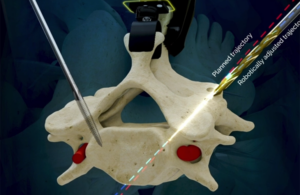
Bern, Switzerland-based LEM Surgical said the milestone introduces further capabilities to its surgical humanoid architecture for the global orthopedic and spine surgery market. It adds individual vertebra tracking using miniature bone‑mounted markers, robotic bi-manual stabilization workflow option, and the introduction of cervical indications.
LEM Surgical designed Dynamis as an integrated, navigation-based robotic platform. The system’s unique upper torso humanoid configuration consolidates into a single compact cart that fits partially beneath the surgical table. It also supports a range of third-party surgical instruments and implants. This optimizes hospital workflow efficiency and reduces facility adoption friction.
Dynamis features three robotic arms, with two for surgical guidance and one for optical navigation. It aims to enhance intraoperative accuracy, control and clinical predictability.

Yossi Bar, CEO of LEM Surgical, said:
“For over two decades, the standard architecture in hard tissue robotics has relied on a single robotic arm tethered to a stationary navigation camera. Our second FDA clearance marks a pivotal step forward. For the first time, a surgical robot can independently and continuously track multiple vertebrae using one arm to stabilize and control a specific segment while the second arm executes clinical intervention. This upper torso humanoid design enables a safer, highly controlled, and predictable environment that is essential for scalability. We are committed to reshaping the hard tissue landscape by delivering a superior platform capable of executing advanced clinical interventions in previously untapped areas.”

