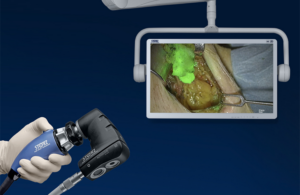
El Segundo, California-based Karl Storz says the clearance broadens its near-infrared (NIR) imaging ecosystem. It now spans open and minimally invasive procedures in the U.S.
The company’s Rubina Lens exoscope displays a real-time, magnified 4K image of the surgical field on a monitor. It offers the ability to switch into NIR imaging using indocyanine green (ICG) to help reveal important information invisible to the naked eye. This supports more informed decision-making during open surgery.
Karl Storz received approval for the Rubina Lens in real-time tissue perfusion assessment, lymphatic mapping, and breast surgery. It designed the system for use in any open surgical procedure where NIR imaging with ICG may support intraoperative decision-making.
Like the fully endoscopic version, Rubina Lens offers several options for viewing the NIR/ICG fluorescence imaging signal. It integrates directly with existing Karl Storz images and Rubina imaging platforms. This enables the expansion of fluorescence capabilities without additional capital investment. The exoscope can be used handheld or mounted on a holding arm for flexibility across surgical settings.
Karl Storz already has approval for Rubina Lens outside the U.S.
“The Rubina Lens extends real-time fluorescence visualization into open surgery, integrating seamlessly with existing OR platforms,” said Fernando Morales, Vice President, Surgical & OR Integration, KARL STORZ United States. “It enables surgeons to incorporate NIR imaging into open procedures without unnecessary complexity or workflow burden.”
This marks the latest milestone for Karl Storz. The company recently inked a partnership with Medtronic on ENT surgery, not long after entering a partnership with Smith+Nephew on advanced surgical technology.