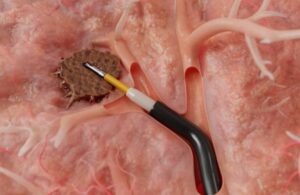
AFFINITY, a prospective, non-randomized, open-label, single-arm study evaluates the safety and feasibility of the company’s Aliya platform. Aliya, a pulsed electric field (PEF) system, could deliver therapies for oncology and chronic lung disease.
Galvanizes’ novel PEF platform, a non-pharmacologic intervention, uses non-thermal, short-duration, highly focused electrical pulses. It destabilizes cellular pathologic processes in the hopes of changing the disease trajectory.
Unlike traditional thermal ablation, Aliya’s short-duration, high-voltage pulses induce cell death without damaging surrounding sensitive structures. The procedure can take place percutaneously or endoscopically with the Inumi Flex needle. To date, the company reports more than 2,000 patients receiving Aliya ablation, both commercially and in U.S. trials. The system has FDA 510(k) clearance for the surgical ablation of soft tissue. (Read more about the technology at Medical Design & Outsourcing).
Redwood City, California-based Galvanize is led by Doug Godshall, who joined as chair and CEO in September alongside a $100 million funding round. Godshall previously served as CEO of HeartWare before its $1 billion acquisition by Medtronic in 2016. Then, he led Shockwave Medical as CEO until its $13.1 billion acquisition by Johnson & Johnson MedTech last year.
The company’s latest update on its Aliya platform includes six-month results from 28 evaluable patients who received lung tumor ablation, followed by additional standard-of-care treatment when deemed appropriate by the treating physician and multidisciplinary team members.
“The AFFINITY results further heighten our confidence in the Aliya PEF ablation technology,” said Godshall. “We are compelled to find ways to improve the lives of the patients our clinical partners treat and we continue to invest in research to demonstrate Aliya PEF’s ability to effectively ablate tumors locally while also stimulating the body’s immune system.”
More on the Galvanize Therapeutics study results
According to a news release, AFFINITY demonstrated that Aliya PEF ablation at the time of diagnostic biopsy is safe and does not preclude administration of subsequent therapies.
The study saw high local control rates of ablated tumors. It achieved this at a 94% rate in 16 patients on concurrent therapy and 100% in 12 patients with no additional therapy. Data also suggested that Aliya may induce systemic immune activation in patients with stage IV non-small cell lung cancer (NSCLC) or metastasis to the lung who are not surgical candidates.
Six-month findings included the successful delivery of PEF ablation in 100% of patients. Investigators found procedures well-tolerated, including bilateral ablations. They saw no delays to standard-of-care therapy and only one percutaneous procedure-related serious adverse event (pneumothorax) resolved without sequelae.
Nearly all (96%) of patients achieved local tumor control. This was defined as local stable disease, local partial response or local complete response of ablated lesions in the lungs. All patients who received ablation alone (12) achieved local control of treated lesions without subsequent systemic therapy.
Patients who received Aliya without subsequent therapy experienced a “robust activation of both adaptive and innate immunity.” This fell in line with immunogenic therapies like cancer immunotherapy or vaccination, Galvanize said.
“These data provide encouraging evidence that Aliya PEF ablation can achieve meaningful local control even in patients with advanced, metastatic disease,” Dr. Michael A. Pritchett, director, Chest Center of the Carolinas and interventional pulmonologist at First Health of the Carolinas and investigator in the study. “Equally important, we’re seeing evidence that Aliya PEF may also trigger systemic immune activation. These findings suggest a promising opportunity to provide focal ablation adjunctive with immunotherapy to potentially enhance outcomes.”