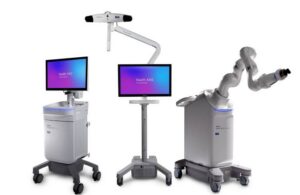
Stealth AXiS brings planning, navigation and robotics together into a single, intelligent system. It combines familiar navigation workflows with a modular robotic design, the medtech giant says. It allows institutions to deploy what they need and expand over time as needs evolve. The company built the system on its existing Mazor and StealthStation technologies.
One major feature comes in the form of AI-enabled architecture. It supports advanced planning and visualization before, during and after surgery.
Medtronic earned back-to-back FDA nods for Stealth AXiS to kick off 2026, first garnering clearance for spine surgery, then getting the green light for cranial and ENT procedures. It also has a partnership with GE HealthCare to integrate the platform with intraoperative ultrasound technology.
(Learn more about Medtronic and the surgical robotics space in our MassDevice Surgical Robotics Special Report. Download the report for free here.)
Michael Carter, SVP and president of Medtronic Cranial & Spinal Technologies, spoke to MassDevice recently to outline the benefits of the system.
Dr. Christopher Good, Dr. Colin Haines and Dr. Ehsan Jazini performed the procedure at HCA Virginia’s Reston Hospital Center. The patient underwent a staged procedure that included a single-level direct lateral interbody fusion (DLIF) followed by a three-level posterior instrumented spinal fusion with laminectomy and bilateral SI joint fusion.
The doctors reported real-time segmental tracking, integrated navigation and robotic guidance with Stealth AXiS. They experienced enhanced accuracy, optimized alignment, reduced radiation exposure and a safer, more optimized recovery for the patient.
Medtronic believes its the system’s flexible architecture supports continuous software innovation and expanded capabilities. It hopes the deeper ecosystem of connectivity helps to shape the “next era of surgery.
Commentary from the doctors using the Medtronic Stealth AXiS platform
Dr. Christopher Good said:
“This is more than an evolution of surgical technology; it’s a shift in what patients can expect from spine surgery in the future. At VSI, we’re leading an era where precision and confidence are higher than ever, and that improves the surgical experience and, most importantly, optimizes recovery for our patients.”
Dr. Ehsan Jazini said:
“This advancement in technology allows us to take an even more individualized approach to every surgery.”
Dr. Colin Haines said:
“Each patient’s spine is unique, and having real-time insight throughout the procedure helps us tailor each decision to the patient in front of us. Ultimately, it’s enabling us to deliver safer care, minimize disruption to the body, and help patients return to the lives they want to live as quickly as possible.”

