• Skip to primary navigation
  • Skip to main content
  • Skip to primary sidebar
  • Skip to footer

MassDevice

The Medical Device Business Journal — Medical Device News & Articles | MassDevice

  • Special Reports
  • Technologies
    • Artificial Intelligence (AI)
    • Cardiovascular
    • Orthopedics
    • Neurological
    • Diabetes
    • Surgical Robotics
  • Business & Finance
    • Wall Street Beat
    • Earnings Reports
    • Funding Roundup
    • Mergers & Acquisitions
    • Initial Public Offering (IPO)
    • Legal News
    • Personnel Moves
    • Medtech 100 Stock Index
  • Regulatory
    • Food & Drug Administration (FDA)
    • Recalls
    • 510(k)
    • Pre-Market Approval (PMA)
    • MDSAP
    • Clinical Trials
  • Resources
    • About MassDevice
    • Leadership in Medtech
    • Manufacturers & Suppliers Search
    • MedTech100 Index
    • Videos
    • Webinars
    • Whitepapers
    • Voices
    • In-Depth Coverage
    • Latest News
  • Attend DeviceTalks
    • Events
      • DeviceTalks Minnesota – May 4
      • DeviceTalks Boston – May 27–28
      • DeviceTalks West
      • DeviceTalks Tuesdays
    • DeviceTalks Podcast Network
      • DeviceTalks Weekly
      • AbbottTalks
      • Boston ScientificTalks
      • DeviceTalks AI
      • IntuitiveTalks
      • MedtechWOMEN Talks
      • MedtronicTalks
      • Neuro Innovation Talks
      • Ortho Innovation Talks
      • Structural Heart Talks
      • StrykerTalks
  • Advertise
  • Subscribe
Home » Distalmotion wants to solve healthcare’s biggest problems. It’s starting with ASCs

Distalmotion wants to solve healthcare’s biggest problems. It’s starting with ASCs

March 27, 2026 By Skyler Rivera

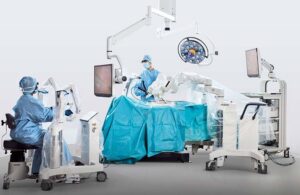
Distalmotion's surgical robot system, Dexter, in an operating room.
Dexter consists of two small instrument arm carts, an endoscopic arm cart and an open sterile surgeon console. [Image courtesy of Distalmotion]
A decade ago, ambulatory surgical centers (ASCs) performed more than half of all outpatient surgeries. Since then, the volume of procedures performed at ASCs has grown by an average of 6% each year, and there are no signs of slowing down.

ASC outpatient facilities are forecast to grow 9% in volume between 2023 and 2028, higher than the expected 7% growth in hospital outpatient department volumes, according to a Colliers report, and to generate $57 billion in revenue by 2030.

As medtech innovation pushes the boundaries of minimally invasive technology and evolves to address payers’ increasing demand for cost-efficient care, low-acuity procedures have migrated from hospitals to ambulatory centers and unlocked an industry of opportunity for soft-tissue surgical robotics companies. 

But, there’s a problem: financial constraints and limited clinical space restrict ASCs’ access to most commercially available surgical robotics systems. Swiss surgical robotics company Distalmotion aims to solve this problem with its Dexter surgical robotics system, designed for ambulatory surgical center environments. 

“We’re solving access…there are a lot of robots that are going to serve high acuity cases in the hospital, and we do that,” Distalmotion CEO Greg Roche said on a recent DeviceTalks Weekly podcast. “But our focus is to create access where you can’t have it normally with traditional systems. We feel it’s a bit of a blue ocean for us.”

Find out more about Distalmotion and 72 other surgical robotics companies in the MassDevice Surgical Robotics Special Report. Download it for free here. 

Solving the space problem

The world doesn’t necessarily need more robots, Roche said, it needs purpose-built robots that solve big problems. Distalmotion focused first on solving ASC’s physical barriers.

Headshot image of Distalmotion CEO Greg Roche
Distalmotion CEO Greg Roche [Image courtesy of Distalmotion]
The majority of Medicare-certified ASCs have one to two operating rooms per facility, according to ASC Data in 2025. A single operating room hosts an average of 1,104 cases per year, in addition to the average procedure room caseload of 1,357 annual cases per room. (Procedure rooms could also serve as a sterile environment for minimally invasive surgeries.)

In high-volume ASCs, there’s often no dedicated room large enough to accommodate commercially available surgical robots, and moving and prepping large robotic systems for the next surgery disrupts efficiency.

“It’s just not enough space,” Roche said. “Because you have the tower, the console, the robot itself — it’s a lot of space. We free that up.”

Distalmotion’s modular robotic surgery system Dexter was designed to increase efficiency through its mobility and flexibility elements. The system consists of two small instrument arm carts, an endoscopic arm cart and an open sterile surgeon console. Roche called the system “minimalistic” but highly mobile, able to move through a standard door frame.
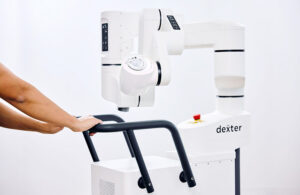
An arm cart in Distalmotion's robotic system, Dexter.
Distalmotion’s modular robotic surgery system was designed to increase efficiency through its mobility. [Image courtesy of Distalmotion]
Roche said Dexter’s mobility could drive efficiency relative to volume with a concept he called, “flip room robotics.”

“You can be performing a hernia surgery and when you’re done using the robot, and the patient’s coming out of anesthesia, that robot can be moved.” Roche said. “You’re moving that robot away and now, to the next room.”

Dexter’s sterile draped console and compatibility with single-use instruments also minimize the need for advanced sterilization between procedures, cutting costs for ASCs and improving efficiency.

Designed for flexibility, integration

Distalmotion’s surgeon console differs from its closed-console competitors. In Dexter-assisted procedures, the surgeon and the open console are in the sterile field.

“We felt from a safety perspective, and from an efficacy perspective, that the ability for the surgeon to be able to touch the patient, not sit at a console across the room, was important,” Roche said. “It also allows them to choose how they want to approach that particular surgery.”

Since the surgeon is already in the sterile field, they can easily switch between laparoscopic and robotic techniques without redocking.

An arm cart in Distalmotion's robotic system, Dexter.
Distalmotion’s modular robotic surgery system was designed to increase efficiency through its mobility. [Image courtesy of Distalmotion]
“Our approach is one of allowing the surgeon to choose the ecosystem that they present to that patient for that particular procedure,” Roche said. “We’re not dictating the ecosystem.”

Distalmotion designed Dexter with simplicity to give surgeons and ASCs flexibility to integrate imaging, instruments and surgical tools that best align with their clinical and economic ecosystems. 

Distalmotion offers five surgical fully-wristed instruments that could be used with its system but Dexter is compatible with advanced instruments and energy systems manufactured by outside companies. 

“Part of our value proposition is keeping it very simple,” Roche said. “That allows people to integrate in a much easier fashion. The more you complicate, the harder it is.”

Challenging financial barriers

Distalmotion’s simplistic robotic design allows for flexibility in how the system is used, enabling the company to pursue a wide range of indications — more procedures mean more profit for ASCs.

As of March 2026, Dexter has been FDA-approved for use in inguinal hernia repair, cholecystectomy and hysterectomy, all commonly performed soft tissue procedures at ASCs.

“[These indications] represent about two and a half million procedures total in the U.S.,” Roche said. “That gets us enough substance to really build a financial proposition for an ASC that makes sense.”

Distalmotion entered the surgical robotics market determined to bring surgical robots to ASCs. It recognized economic and clinical problems that barred ASCs from accessing surgical robotic systems and designed its system to solve ambulatory surgical centers’ biggest problems.

“When you look at some of the competitive technologies, they may solve one or two of those things, but not all,” Roche said. “You can have a system that’s mobile, but if it’s $2 million, it’s going to be very difficult to implement that into an ASC.”

DeviceTalks Editorial Director Tom Salemi contributed to this report.

Filed Under: Business/Financial News, Device Talks Podcasts, Featured, Health Technology, Robotic-Assisted, Special Content, Surgical, Surgical Robotics Tagged With: DeviceTalks, DeviceTalks Weekly, Distalmotion

More recent news

  • Medtronic moves to divest final stake in MiniMed
  • Luma Vision wins expanded FDA nod for its cardiac procedure software
  • Meet Conor Hale, MassDevice’s new senior editor
  • Johnson & Johnson MedTech reportedly could sell DePuy Synthes to Apollo
  • Boston Scientific continues to make progress on cyberattack recovery

About Skyler Rivera

Skyler Rivera is an associate editor at Arrowfly, covering medical device industry news and technology at MassDevice and Medical Design & Outsourcing. She began her career covering sports at The Athletic and MLB before transitioning to medical writing at Edwards Lifesciences. Based in Southern California, she holds a master's degree in science writing from Johns Hopkins University and a bachelor’s in broadcast journalism from Syracuse University. Connect with her on LinkedIn or email at [email protected].

Primary Sidebar

Cart

“md
EXPAND YOUR KNOWLEDGE AND STAY CONNECTED
Get the latest med device regulatory, business and technology news.

DeviceTalks Weekly

See More >
MDO ad
MDO ad

Footer

MASSDEVICE MEDICAL NETWORK

DeviceTalks
Drug Delivery Business News
Medical Design & Outsourcing
Medical Tubing + Extrusion
Drug Discovery & Development
Pharmaceutical Processing World
MedTech 100 Index
R&D World
Medical Design Sourcing

DeviceTalks Webinars, Podcasts, & Discussions

Attend our Monthly Webinars
Listen to our Weekly Podcasts
Join our DeviceTalks Tuesdays Discussion

MASSDEVICE

Subscribe to MassDevice E-Newsletter
Advertise with us
About
Contact us

Copyright © 2026 · Arrowfly LLC and its licensors. All rights reserved.
The material on this site may not be reproduced, distributed, transmitted, cached or otherwise used, except with the prior written permission of Arrowfly.

Privacy Policy