• Skip to primary navigation
  • Skip to main content
  • Skip to primary sidebar
  • Skip to footer

MassDevice

The Medical Device Business Journal — Medical Device News & Articles | MassDevice

  • Special Reports
  • Technologies
    • Artificial Intelligence (AI)
    • Cardiovascular
    • Orthopedics
    • Neurological
    • Diabetes
    • Surgical Robotics
  • Business & Finance
    • Wall Street Beat
    • Earnings Reports
    • Funding Roundup
    • Mergers & Acquisitions
    • Initial Public Offering (IPO)
    • Legal News
    • Personnel Moves
    • Medtech 100 Stock Index
  • Regulatory
    • Food & Drug Administration (FDA)
    • Recalls
    • 510(k)
    • Pre-Market Approval (PMA)
    • MDSAP
    • Clinical Trials
  • Resources
    • About MassDevice
    • Leadership in Medtech
    • Manufacturers & Suppliers Search
    • MedTech100 Index
    • Videos
    • Webinars
    • Whitepapers
    • Voices
    • In-Depth Coverage
    • Latest News
  • Attend DeviceTalks
    • Events
      • DeviceTalks Minnesota – May 4
      • DeviceTalks Boston – May 27–28
      • DeviceTalks West
      • DeviceTalks Tuesdays
    • DeviceTalks Podcast Network
      • DeviceTalks Weekly
      • AbbottTalks
      • Boston ScientificTalks
      • DeviceTalks AI
      • IntuitiveTalks
      • MedtechWOMEN Talks
      • MedtronicTalks
      • Neuro Innovation Talks
      • Ortho Innovation Talks
      • Structural Heart Talks
      • StrykerTalks
  • Advertise
  • Subscribe
Home » Study supports SpineX neuromod system for treating children with cerebral palsy

Study supports SpineX neuromod system for treating children with cerebral palsy

October 5, 2022 By Sean Whooley

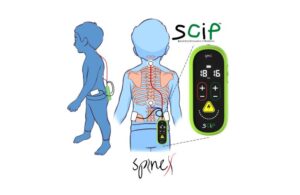
SpineX SCIP children cerebral palsy
[Image from SpineX]
SpineX announced today that its first-in-human study backs the use of its proprietary non-surgical treatment for children with cerebral palsy (CP).

Los Angeles-based SpineX published the study in Nature Communications. Dr. Susan Hastings and Dr. V Reggie Edgerton led the study.

SCiP demonstrated functional improvements with SCiP (spinal cord innovation in pediatrics) in children with CP. The study combined non-invasive spinal neuromodulation and activity-based neurorehabilitation therapy, SpineX said in a news release.

SpineX said SCiP delivery during physical therapy improved sensorimotor function in 16 of 16 children. This patient population included a wide range of ages and CP severity. The treatment holds breakthrough device designation from the FDA. The company plans to align with the agency for a proposed clinical trial for 2023. It plans to use the results to pursue FDA clearance for SCiP in the treatment of CP.

The SCiP neuromodulation device provides transcutaneous spinal cord neuro-stimulation. SpineX designed it to potentially treat the underlying neurological dysfunction in pediatric patients with CP. The company said it aims to make SCiP the first medical device in the U.S. for treating CP “by transforming the brain and spinal cord dysfunctional connectivity into highly functional systems.”

‘A world of possibilities’ with the SpineX SCiP system

“At just 3 years old and highly affected by CP, our son has shown such exciting progress since he began using SCiP,” Dana, the mother of a young boy diagnosed with CP who was enrolled in a clinical study sponsored by SpineX, said in the news release. “We’re so grateful that our son was included in the clinical study with SCiP as it has opened up a world of possibilities for our son, and we hope others will be able to witness it soon.”

SpineX also holds FDA breakthrough device designation for its SCONE device for treating neurogenic bladder. The company enrolled the first patient in its trial for the system in June.


Filed Under: Clinical Trials, Featured, Neurological, Neuromodulation/Neurostimulation, News Well, Pediatrics Tagged With: SpineX

More recent news

  • Zimmer Biomet, Think Surgical extend exclusive distribution agreement
  • Cambridge Heartwear inks £184M deal to supply NHS with portable ECG monitors
  • J&J, Smith+Nephew plans for ortho megamerger reportedly fall through
  • California and Massachusetts still reign as top US medtech headquarters locations
  • Teleflex wins Breakthrough Device designation for Freesolve resorbable scaffold

About Sean Whooley

Sean Whooley is a senior editor who mainly produces work for MassDevice, Medical Design & Outsourcing and Drug Delivery Business News. He received a bachelor's degree in multiplatform journalism from the University of Maryland, College Park. You can connect with him on LinkedIn or email him at [email protected].

Primary Sidebar

“md
EXPAND YOUR KNOWLEDGE AND STAY CONNECTED
Get the latest med device regulatory, business and technology news.

DeviceTalks Weekly

See More >
MDO ad
MDO ad

Footer

MASSDEVICE MEDICAL NETWORK

DeviceTalks
Drug Delivery Business News
Medical Design & Outsourcing
Medical Tubing + Extrusion
Drug Discovery & Development
Pharmaceutical Processing World
MedTech 100 Index
R&D World
Medical Design Sourcing

DeviceTalks Webinars, Podcasts, & Discussions

Attend our Monthly Webinars
Listen to our Weekly Podcasts
Join our DeviceTalks Tuesdays Discussion

MASSDEVICE

Subscribe to MassDevice E-Newsletter
Advertise with us
About
Contact us

Copyright © 2026 · Arrowfly LLC and its licensors. All rights reserved.
The material on this site may not be reproduced, distributed, transmitted, cached or otherwise used, except with the prior written permission of Arrowfly.

Privacy Policy