
The Fort Lauderdale, Florida-based company showcased its technologies at the Global Multi-Specialty Robotic Surgery Conference (SMRSC 2026) in New Delhi, India. Innovations highlighted included the SSi Vimana Aero drone system, the SSi Avtara humanoid surgical platform, the SSi Operion mobile operating room. The company also unveiled a new single-arm robotic endoscopy and ultrasound assist carts.
The new technologies add to the company’s existing Mantra platform. SS Innovations’ Mantra — which it submitted to the FDA for 510(k) clearance at the end of 2025 — features a modular, 3D vision, open-console design with ergonomics that the company describes as superior. It engages machine learning models to improve safety and efficiency during procedures.
Read more about SS Innovations and the surgical robotics industry by downloading our free MassDevice Surgical Robotics Special Report.
“Innovation is in our DNA. Beyond continuously improving our advanced, cost-effective SSi Mantra surgical robotic system and telesurgery capabilities, we strive to pioneer new surgical robotic technologies that will meaningfully improve healthcare for a wider segment of patients in need. SMRSC 2026, our largest conference yet, successfully elevated this important theme,” said Dr. Sudhir Srivastava, chair and CEO of SS Innovations.
The company completed the first robotic cardiac surgeries in the Americas with the system in June 2025. Then, it reported the first robotic telesurgery for weight loss a couple of weeks later. In September 2025, it announced the world’s first pediatric pyeloplasty telesurgery using Mantra. Then, in November 2025, the company completed the first telesurgery performed with its new Tele Surgeon Console (TSC). That built up to its December submission to the FDA.
More about the SS Innovations Vimana Aero drone
SS Innovations said its Vimana Aero, currently under development, is designed to bring expert robotic surgical care directly to wounded soldiers in active battle zones — a goal that harkens back to surgical robotics’ roots in DARPA projects in the late 20th century. The robotic surgery drone aims to bridge the gap between initial point of injury and eventual medical evacuation.
Deployed via a heavy-lift autonomous drone, Vimana Aero can land in proximity to the casualty. There, it can deploy two miniature robotic arms with seven degrees of freedom. A trauma surgeon can remotely operate the system, equipped with 5 mm surgical instruments.
SS Innovations said it designed the platform to address hemorrhaging, wound repair, chest decompression, shrapnel extraction and field suturing, among other procedures, to help stabilize patients until evacuation teams arrive.
More about the Avtara humanoid system
Avtara, another offering under development, aims to utilize the mobility, dexterity and perception capabilities of humanoid robotics. The company hopes to deliver high-impact surgical robotic applications across healthcare, defense, logistics, disaster response and industrial settings.
Using AI, teleoperating frameworks and real-time sensing, SS Innovations designed Avtara for training, continuous learning, adaptability and precision.
The company expects the platform to assist clinical workflows and operate in hazardous or otherwise inaccessible environments.
More about the Operion operating room platform
Operion, a fully mobile, platform-agnostic operating room ecosystem, aims to deliver seamless deployment across hospitals, remote locations, combat areas and disaster zones.
SS Innovations built the platform on a wheeled chassis with overhead-integrated robotics and a zero-footprint architecture. It hopes to eliminate spacial constraints by suspending all surgical components in an integrated overhead system. This could enable 360-degree clinician access, real-time configuration and seamless deployment.
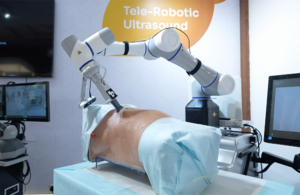
More about the new single-arm robotic carts
Finally, the company’s new single-arm robotic endoscopy and ultrasound assist carts aim to provide stable, precise and repeatable positioning of endoscopic and ultrasound instruments within clinical environments.
SS Innovations said it wants to bring robotic consistency to workflows, incorporating controlled speed, force limits and predictable motion behavior.
The company designed the system, currently under development, for compatibility with standard hospital infrastructure and existing workflows.