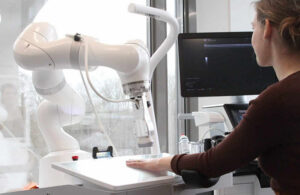
Danish medtech company Ropca will bring its autonomous musculoskeletal ultrasound system to the U.S. after receiving FDA 510(k) clearance.
The system features two components: Arthur and Diana, which together capture and analyze ultrasound images of finger, hand and wrist joints.
Arthur performs standardized musculoskeletal ultrasound scans, and Diana, an AI software, develops AI-assisted analyses and reports to assist healthcare professionals with clinical decision-making.
“FDA 510(k) clearance for Arthur & Diana is a defining moment for Ropca,” Ropca CEO Johannes Schaeferhoff said in a news release. “For providers, it can help address capacity and consistency; for patients, it points toward faster access to specialist assessment. We are now ready to build the U.S. clinical and commercial partnerships that take this new category forward.”
Related: Globus Medical wins CE mark for Excelsius3D imaging system
The device has been approved for sale in the European Union since 2022, with more than 5,400 scans and 83,500 joints scanned across six countries to date, the company said.

Until now, Ropca’s work with Arthur and Diana in the U.S. has been focused on research and clinical validation. With FDA 510(k) clearance, the company sees an opportunity for the device to fill in gaps in rheumatology.
“Arthur brings something particularly valuable to rheumatology: the ability to obtain standardized, reproducible ultrasound assessments of joints autonomously and efficiently,” said Dr. Matthew Koster, Associate Professor of Medicine, Division of Rheumatology at the Mayo Clinic, in a news release.
Nearly three-quarters of U.S. counties don’t have practicing rheumatologists, despite about one in four Americans being diagnosed with a rheumatic disease, according to the American College of Rheumatology.
“As demand for rheumatologic care grows faster than our specialist workforce, technologies like Arthur have the potential to expand access to objective imaging, increase clinical capacity, and help rheumatologists deliver more efficient and consistent care to patients with inflammatory arthritis,” Koster said.