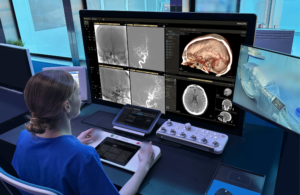
Under the award, Philips will partner with Johns Hopkins and Boston University on remote and automated endovascular procedure technology, working alongside J Mocco of Weill Cornell Medicine as a clinical collaborator.
The award was given as part of ARPA-H’s Autonomous Interventions and Robotics (AIR) program, which aims to increase access to life-saving surgeries by enabling robots to perform procedures without human input.
“Each year, hundreds of thousands of Americans suffer strokes caused by clots that block large blood vessels in the brain, yet only about 12% of those who need the most effective treatment — thrombectomy — receive it. Too many are left to face lifelong consequences, including disability, memory loss, depression, and chronic pain,” AIR Program Manager Ileana Hancu said in an ARPA-H press release. “Through AIR, ARPA-H is mobilizing the nation’s most advanced technological and clinical expertise to revolutionize surgical care and develop curative stroke treatments for patients.”
Siemens Healthineers also won an award under the program, for up to $31.1 million over five years to develop remote endovascular robotics to treat acute ischemic stroke.
Philips will use its award to develop technologies for “endovascular navigation, robotic device control, image-based procedural guidance, workflow automation and remote intervention,” the company said in a press release.
“This ARPA-H program accelerates our long-term vision for image-guided intervention,” Bert van Meurs, Chief Business Leader Image-Guided Therapy at Philips, said in a press release. “We’re helping shape a future where expert care is no longer limited by geography or workforce constraints. The goal is not to replace expertise, but to make expertise scalable and accessible.”
Other awardees under the AIR program include:
- Megnendo, which will develop an autonomous endovascular robot that uses a magnet to direct guideware to perform neurointerventional procedures.
- The University of California, San Diego, to develop a flexible robot that moves through the vasculature to the brain.
- Kitware, which will provide a virtual simulation and validation testbed for the robots developed by Siemens, Philips, Magnendo and UCSD.
- Stanford University, which will develop an intravascular magnetic helical device that can autonomously debulk and extract blood clots.
- The University of California, Berkeley, which will build a small crawling robot that can move through the body to take tissue samples and navigate the brain to connect ventricles.