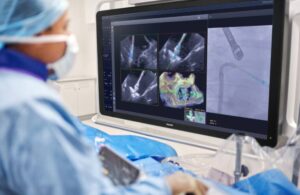
The Amsterdam-based medtech giant designed DeviceGuide to assist physicians during minimally invasive repair procedures for leaking heart valves (mitral regurgitation or MR). It built the solution on its EchoNavigator platform to bring AI directly into the procedure room.
According to Philips, DeviceGuide translates complex imaging into intuitive, real-time visual guidance. It helps clinicians navigate the beating heart with greater clarity and confidence, the company says.
“With DeviceGuide, we’re bringing AI into the heart of the procedure room, and into the heart itself,” said Dr. Atul Gupta, chief medical officer, Diagnosis & Treatment at Philips. “This is Philips’ first AI assisting physicians in real time to visualize and guide heart valve treatment devices as they navigate the beating heart. It’s helping doctors in the moment as they are helping their patients with structural heart disease.”
More about the new Philips DeviceGuide offering
DeviceGuide offers an option for patients who require mitral transcatheter edge-to-edge repair (M-TEER). This procedure requires valve repair through a tiny incision in the top of the leg in the groin area. The physician guides long, flexible instruments through the blood veins and navigate a miniature repair device into the beating heart. Leading TEER solutions in the space include Edwards’ Pascal and Abbott’s TriClip and MitraClip.
Philips developed its solution in collaboration with Edwards, combining medical imagine expertise with leadership in structural heart devices. The companies say that, together, they reimagined key parts of the mitral TEER procedural workflow.
When performing TEER, clinicians require both X-ray and ultrasound images on multiple screens. They have to coordinate movements between two operators and make precise adjustments to grasp moving valve leaflets, position the repair device and confirm the result in real time. The process requires accuracy, coordination and experience.
Philips said its DeviceGuide helps with this by using an AI algorithm to automatically track the repair device as it moves through the heart. It intelligently combines live echo and X-ray images and creates a virtual 3D model of the treatment device in real time. The technology superimposes this model on the live images of the beating heart so clinicians can get a clear view of the procedure. Altogether, it helps them navigate the device more easily to effectively seal the leak.
“The AI software serves as an assistive tool, with the physician always remaining in control. This isn’t about replacing expertise – it’s about amplifying it,” said Gupta. “By embedding AI into the procedure, DeviceGuide gives physicians an extra pair of eyes, effectively bionic vision, helping them treat more patients safely and confidently.”