• Skip to primary navigation
  • Skip to main content
  • Skip to primary sidebar
  • Skip to footer

MassDevice

The Medical Device Business Journal — Medical Device News & Articles | MassDevice

  • Special Reports
  • Technologies
    • Artificial Intelligence (AI)
    • Cardiovascular
    • Orthopedics
    • Neurological
    • Diabetes
    • Surgical Robotics
  • Business & Finance
    • Wall Street Beat
    • Earnings Reports
    • Funding Roundup
    • Mergers & Acquisitions
    • Initial Public Offering (IPO)
    • Legal News
    • Personnel Moves
    • Medtech 100 Stock Index
  • Regulatory
    • Food & Drug Administration (FDA)
    • Recalls
    • 510(k)
    • Pre-Market Approval (PMA)
    • MDSAP
    • Clinical Trials
  • Resources
    • About MassDevice
    • Leadership in Medtech
    • Manufacturers & Suppliers Search
    • MedTech100 Index
    • Videos
    • Webinars
    • Whitepapers
    • Voices
    • In-Depth Coverage
    • Latest News
  • Attend DeviceTalks
    • Events
      • DeviceTalks Minnesota – May 4
      • DeviceTalks Boston – May 27–28
      • DeviceTalks West
      • DeviceTalks Tuesdays
    • DeviceTalks Podcast Network
      • DeviceTalks Weekly
      • AbbottTalks
      • Boston ScientificTalks
      • DeviceTalks AI
      • IntuitiveTalks
      • MedtechWOMEN Talks
      • MedtronicTalks
      • Neuro Innovation Talks
      • Ortho Innovation Talks
      • Structural Heart Talks
      • StrykerTalks
  • Advertise
  • Subscribe
Home » NextSense debuts brain activity-sensing headphones to improve sleep

NextSense debuts brain activity-sensing headphones to improve sleep

February 9, 2026 By Skyler Rivera

NextSense has launched a pair of wireless earbuds, called Smartbuds, that measure real-time electrical activity in the brain and respond with audio stimulation to guide users into deeper sleep.
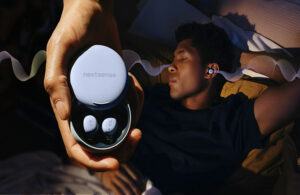
A photo of the Smartbuds headphones and a person using them while sleeping.
Smartbuds use six electroencephalography (EEG) sensors to measure the brain’s electrical activity. [Image courtesy of NextSense]
In the statement released today, NextSense said Smartbuds were designed to “close the gap between passive sleep tracking and active intervention” with its innovative wearable technology.

“​​Sleep shapes how we show up in the world. Yet for too long, technology has treated it like a score to track instead of a state to support,” said NextSense CEO and founder Jonathan Berent. We built Smartbuds to give people what they actually want and need: better rest.”

Smartbuds use six electroencephalography (EEG) sensors to measure the brain’s electrical activity and detect when users are in light sleep, deep sleep or drifting away; differing from other sleep tracking wearables that use motion or heart rate.

As the user falls deeper into sleep, the brain produces slower, low-frequency energy bursts, called brain waves. These slow waves are observed during deep sleep when the body enters a restorative state often tied with recovery, memory consolidation and next-day alertness.

Smartbuds was designed to help users stay in deep sleep longer. The earbuds deliver precisely timed sound frequencies, called soft pink noise, that nudge the brain’s waves into a restorative rhythm, strengthening deep sleep.

The earbuds learn individual sleep patterns over time, giving users a personalized experience based on their own neural rhythms.

In beta testing data released in today’s statement, Smartbuds were shown to increase slow-wave activity with almost 50% of users reporting having “better” or “much better” sleep with improved morning recovery.

About 50 to 70 million Americans live with sleep or wakefulness disorders, according to the National Heart, Lung and Blood Institute. Poor sleep is often linked to cardiovascular disease, metabolic disorders, depression, anxiety, cognitive declines and reduced daily performance.


Filed Under: Digital Health, Health Information Technology, Health Technology, Neurological Tagged With: Sleep Data, wearable sensors, wearables

More recent news

  • Abbott sets Libre Duo glucose-ketone sensor US launch for December
  • Edwards wins FDA approval for Pascal Precision in tricuspid valve repair
  • Danaher’s Masimo acquisition offsets drops in respiratory diagnostic sales
  • Intuitive stock slides as US procedures slow amid $450M settlement
  • Abbott to spin out Nutrition business, cuts guidance

About Skyler Rivera

Skyler Rivera is an associate editor at Arrowfly, covering medical device industry news and technology at MassDevice and Medical Design & Outsourcing. She began her career covering sports at The Athletic and MLB before transitioning to medical writing at Edwards Lifesciences. Based in Southern California, she holds a master's degree in science writing from Johns Hopkins University and a bachelor’s in broadcast journalism from Syracuse University. Connect with her on LinkedIn or email at [email protected].

Primary Sidebar

“md
EXPAND YOUR KNOWLEDGE AND STAY CONNECTED
Get the latest med device regulatory, business and technology news.

DeviceTalks Weekly

See More >
MDO ad
MDO ad

Footer

MASSDEVICE MEDICAL NETWORK

DeviceTalks
Drug Delivery Business News
Medical Design & Outsourcing
Medical Tubing + Extrusion
Drug Discovery & Development
Pharmaceutical Processing World
MedTech 100 Index
R&D World
Medical Design Sourcing

DeviceTalks Webinars, Podcasts, & Discussions

Attend our Monthly Webinars
Listen to our Weekly Podcasts
Join our DeviceTalks Tuesdays Discussion

MASSDEVICE

Subscribe to MassDevice E-Newsletter
Advertise with us
About
Contact us

Copyright © 2026 · Arrowfly LLC and its licensors. All rights reserved.
The material on this site may not be reproduced, distributed, transmitted, cached or otherwise used, except with the prior written permission of Arrowfly.

Privacy Policy