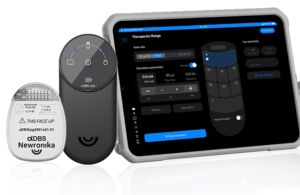
Milan-based Newronika said its latest aDBS system features full integration with WebBioBank, its proprietary, cloud-based neural data platform. It builds upon the already CE-marked Newronika aDBS platform for treating Parkinson’s disease.
The company said CE mark represents the first approval for an aDBS system that continuously senses neural activity and automatically adjusts stimulation according to patient-specific adaptive therapy settings, transmitting the data into a fully integrated neural data cloud platform. Its platform understands the brain’s signals and helps to deliver better outcomes. The company aims for fewer side effects, fewer clinical visits and reduced burden on patients and clinicians.
Newronika’s aDBS, powered by a patented adaptive therapy stim engine, continuously senses local field potential (LFPs). It reads the brain’s signals in real time and adjusts stimulation to keep each patient within their optimal therapeutic workflow.
Each system includes an implantable pulse generator (IPG), a physician interface, and a patient remote. It all enables seamless at-home data collection. Its components enable a connected care model that continuously transmits patient data for clinicians to support ongoing therapy optimization.
WebBioBank technology collects and analyzes neuronal signals integrated with clinical data across participating centers. It builds a longitudinal, de-identified neural data repository. This can help to uncover the neurophysiological dynamics of deep brain structures, characterize DBS mechanisms of action, and develop new adaptive DBS algorithms.
With CE mark, Newronika also continues to evaluate the aDBS system in the U.S., having received FDA investigational device exemption (IDE) last year.
Lorenzo Rossi, co-founder, CEO and CTO of Newronika, said:
“This certification validates our vision of a fully connected, data-driven approach to neuromodulation therapy, and opens a new era in personalized treatment for patients living with Parkinson’s disease and other neurological conditions.”

