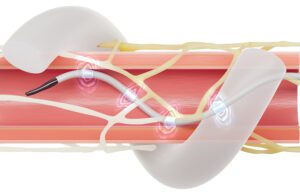
Medtronic today said the first patient has been treated in its pilot study of multi-organ denervation using its nitinol-enabled Symplicity Spyral catheter technology.
The Spyral GEMINI pilot program (an abbreviation for Global pilot study of rEnal and hepatic coMbINed denervatIon) includes off-med and on-med studies investigating the safety and potential efficacy for denervation of both the renal and common haptic (liver) arteries in uncontrolled hypertension patients.
Nitinol innovation: Download our free special report featuring nitinol expertise and tips from medical device OEMs
“In addition to denervation of the renal arteries — where the blood pressure lowering clinical benefit has already been established through multiple rigorously designed clinical trials — targeting other richly innervated vascular areas such as the common hepatic artery is an emerging horizon for treating hypertension,” said the study’s lead principal investigator, Piedmont Heart Institute and Cardiovascular Services Chief Dr. David Kandzari, in a Medtronic news release. “We look forward to learning more about the potential efficacy of denervation in both the liver and renal arteries from Spyral GEMINI.”
Medtronic said preclinical data presented at EuroPCR in May “showed a 90% significant reduction in norepinephrine (marker of sympathetic activity) with multi-organ denervation.”
“These findings suggest that multi-organ denervation using the Spyral system can successfully denervate within both the hepatic and renal arteries,” the company continued.
More from EuroPCR: The biggest cardiovascular tech news out of EuroPCR 2025
Medtronic Renal Denervation (RDN) GM Jason Fontana previously explained the next-generation Project Gemini approach in an interview with MassDevice sister site Medical Design & Outsourcing.
In that interview, Fontana said the device manufacturer had fully developed a new minimally invasive catheter for wrist access that could be on the market sometime in 2026, and that the current radiofrequency (RF) generator should work for the procedure given appropriate adjustments to the RF energy delivery algorithm.
More from Fontana: Medtronic’s RDN GM shares reimbursement advice and his ‘airplane moment’
Medtronic won FDA approval for RDN in 2023 along with Recor Medical, which uses an ultrasound catheter. Those companies are waging a patent battle over their competing technologies.
Hepatic denervation has not been approved by the FDA or any other device regulator, with Medtronic saying the investigational generator and catheter used in the study is not authorized for sale or use anywhere in the world.
The Spyral GEMINI study
Medtronic’s Spyral GEMINI pilot study will enroll up to 175 hypertensive patients in the U.S, Europe and Australia.
The study will have two parallel cohorts, including patients off anti-hypertensive medications and patients with high cardiovascular risk who are taking anti-hypertensive medications. Physicians will use the Symplicity Spyral catheter for denervation in both the common hepatic and main renal arteries and branches.
Medtronic said procedural safety and efficacy evaluation will start three months after the procedures and continue for three years.
The first patient was treated by Dr. Barry Bertolet at Cardiology Associates of North Mississippi and North Mississippi Medical Center in Tupelo.

“As a pioneer in renal denervation, Medtronic is uniquely positioned to explore the clinical potential of multi-organ denervation with Symplicity Spyral’s low profile and single catheter design, and intellectual property in this field,” Medtronic SVP and Coronary and Renal Denervation President Jason Weidman said in the news release. “As a company, Medtronic is committed to investing in strategically important areas that hold promise for patients and the medical community.”
Medical Design & Outsourcing: With Medtronic’s next-gen RDN devices and procedures advancing, Project Galileo is next

