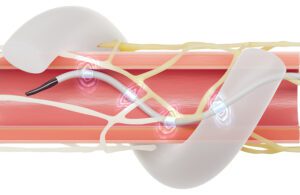
Symplicity Spyral delivers radiofrequency energy to nerves near the kidneys in a minimally invasive procedure to treat hypertension. These nerves can become overactive and contribute to high blood pressure. The RDN system holds approval for commercial use in more than 80 countries.
Medtronic received approval for the system in November 2023, shortly after its competitor Recor Medical won approval for its Paradise system. Boston Scientific is also advancing RDN technology through its acquisition of SoniVie. It has also picked up recent reimbursement wins, including in the U.S. and Japan.
Today, the company shared new results further supporting Symplicity Spyral. It presented findings from a pooled analysis of the SPYRAL HTN program at the Cardiovascular Research Technologies (CRT) 2026 annual meeting.
Findings demonstrated that nearly nine out of 10 patients experience a clinical benefit — reductions in 24-hr ambulatory systolic blood pressure (ABPM), office-based systolic blood pressure (OSBP), or reduction of at least one antihypertensive medication — at three years.
“This late-breaking three-year data reinforces the durable and clinically meaningful impact of the Symplicity blood pressure procedure,” said Jason Weidman, SVP and president of the Coronary and Renal Denervation business at Medtronic. “We’re seeing sustained, significant reductions in blood pressure with Symplicity over time – an important validation of radiofrequency renal denervation as a long-term treatment strategy. As the body of evidence continues to grow, we remain confident in the role of Symplicity Spyral in setting the standard for safe, effective, and lasting blood pressure reductions across a broad spectrum of patients who need more than medication alone.”
A look at the data from Medtronic
Investigators pooled data from 2,137 patients across its global SYMPLICITY Registry DEFINE, SPYRAL First-In-Man, SPYRAL HTN-OFF MED and -ON MED trials. The analysis aimed to determine the proportion of patients who experienced clinical benefit.
Spyral-treated patients saw significant reductions in OSBP and ABPM at three years. Additionally, 88% of patients experienced either an OSBP reduction ≥10 mmHg, a 24-h ABPM reduction ≥5 mmHg, or a reduction of at least one antihypertensive medication at 3 years. Results showed amplified BP reduction through three years with few adverse events.
Dr. David Kandzari, chief of Piedmont Heart Institute and Cardiovascular Services, led the SPYRAL HTN-ON MED trial as lead principal investigator.
“These results represent an important milestone in advancing clinician understanding of the long-term impact of radiofrequency renal denervation for patients with uncontrolled hypertension,” said Kandzari. “We’re seeing sustained blood pressure reductions that get progressively better with time, without an increase in concomitant medication burden. The data also demonstrates the potential to reduce the number of hypertensive medications and simplify treatment protocols – an outcome that we know can make a meaningful difference for patients when it comes to treatment burden and their everyday life.”
Other findings for Symplicity Spyral
Medtronic also presented a pooled analysis of hypertensive urgencies for the SPYRAL HTN-OFF MED and -ON MED trials. The analysis showed that hypertensive urgencies came in 42% lower after radiofrequency RDN with Symplicity Spyral at two-year follow-up.
This study demonstrated potential cost savings, with annual hypertensive urgency-related healthcare costs savings coming in at approximately $199 million per year. The analysis included 703 patients randomized as RF RDN (388 patients) vs. sham (315).
Additionally, Medtronic presented the design for its SPYRAL CARE study. The observational study looks at the Medicare population with uncontrolled hypertension to provide real-world evidence for radiofrequency RDN in this patient population. It was approved by CMS after its National Coverage Determination (NCD) on RDN therapy.
The study will analyze medical and prescription claims linked to electronic health records and evaluate changes in OSBP and major cardiovascular events (non-fatal stroke, non-fatal myocardial infarction, and death) up to two years.