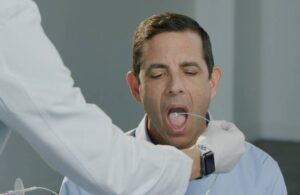
Lucid offers the EsoCheck and EsoGuard platforms that help in detecting cancer and ultimately preventing it. EsoCheck is a quick, non-invasive way for clinicians to collect esophageal cells for analysis, without endoscopy. EsoGuard is a DNA test that has been shown to accurately detect esophageal pre-cancer.
Together, these platforms continue to drive Lucid Diagnostics forward. They represent the first and only commercially available tools designed with the goal of preventing cancer and cancer deaths through widespread, early detection of esophageal pre-cancer in at-risk patients.
With coming milestones on the horizon — including potential Medicare coverage — Aklog spoke to MassDevice at AdvaMed’s The MedTech Conference last month in San Diego.
The following has been lightly edited for space and clarity.
What is Lucid Diagnostics’ mission?
Dr. Lishan Aklog: “We are fundamentally a cancer prevention company. I use that terminology as somewhat distinct from early detection. Typically, when you’re doing early cancer detection, there are not very many examples where we can detect a pre-cancerous condition and have the opportunity to prevent cancer. Cervical is one with pap testing. Colonoscopy, certainly, and, in some examples, stool DNA testing can pick up an advanced adenoma. But, in the cancer we’re dealing with — esophageal cancer — is the second-most lethal cancer. It’s effectively a death sentence. It’s about an 80% mortality overall. We have no choice in this case but to detect the cancer in the pre-cancer stage if you’re going to have any impact on eliminating the 16,000 deaths a year. We can help prevent those cancer deaths. That’s what we’re trying to accomplish.”
What is the company’s offering?
LA: “Unlike in some areas where there’s new, innovative technology, the groundwork had already been very well laid out with regard to who’s at risk. How do you know the enriched population for testing? What do you do when you find the earliest-stage pre-cancer, called Barrett’s esophagus? What do you do when you find the later-stage pre-cancer, called dysplastic Barrett’s esophagus? All of that was already worked out. What was missing was a tool to screen this established target population and identify patients who have these pre-cancerous conditions, so you can put them in either surveillance or in treatment and prevent cancer. So that’s what’s been great about this, is that we’re inserting ourselves into a paradigm that was already well established. We’re not having to sort of figure that out from scratch.
Describe the EsoCheck device
LA: “EsoCheck is a catheter, which has a little capsule at the end of it, and a little balloon attached to that capsule, which the patient could swallow just by sipping water, no anesthesia. The critical part of it, called the collect to protect technology, allows you to collect cells from exactly where on the esophagus these abnormalities occur, in the last couple of inches of the esophagus. Once those cells are collected, it just kind of swabs, like you would, a mouth swab, and the balloon collapses. The patient swallows [the capsule], and once it’s in the stomach, just based on the markings, you pull back, and the balloon swabs that portion of the esophagus, and then the balloon is deflated.
“What’s clever about it is that the cells that were on the outside of the balloon are now inside the capsule. For the remainder of the trip out, it’s not contaminated by cells in the mid- or upper-esophagus or in the mouth. It’s very critical in medicine to get a well-targeted sample. It gives you that, and that gives the molecular test a real fighting chance to find these really subtle changes.”
And EsoGuard?
LA: “EsoGuard is the molecular diagnostic acid. EsoGuard is a methylation test, and it detects these subtle, epigenetic changes on a couple of genes that are known to be correlated with esophageal cancer. By combining those two technologies, we’re able to — with a very high negative predictive value, 99% negative predictive value — say that, if a person’s negative, that they don’t have any of the conditions along the spectrum, from early pre-cancer all the way to late pre-cancer. If people are positive, they get a confirmatory endoscopy and they get routed to the appropriate pathway.”
What makes this offering unique?
LA: “What’s cool about the cell collection part of this is that it’s novel. The molecular test, that’s all the fancy science, but this little simple thing has really revolutionized how you can bring this to groups. You can’t go into a fire department and say we’re going to do endoscopies. But this takes a minute. Literally, you’re in and done in a minute, and suddenly you have a sample, and you can give these people the answer. It’s really, really gratifying.
“[A primary care physician] told a remarkable story. She was sort of skeptical. She read the data and said, ‘OK, I’m going to implement this in my practice.’ The first patient was negative. That patient’s fine. The second patient came back positive, and it convinced them to get an endoscopy. The endoscopy initially showed a late pre-cancer, and they can wipe those out. They can do an ablation procedure to eliminate that and prevent cancer.
“When that patient got sent to the definitive endoscopist who would do that kind of ablation procedure, they found a little microscopic patch of actual cancer. This wasn’t invading anything, but it was just about to get started, so guaranteed, in 1-1.5 years, this would have developed and would have become cancer. The way they would have presented it would have been a big tumor and essentially a death sentence. It’s just been extremely gratifying [to see it work].”
Is there anything else out there that compares to this?
LA: “[There has] not really historically [been anything like this]. The standard of care has been endoscopy, so that’s obviously much more invasive, with anesthesia. If you take this target population of millions of patients who should be tested by guidelines, hardly any of them are getting tested. The need for a non-endoscopic approach and the need to leverage modern-day molecular biomarkers and combine those with an alternative to endoscopy were always very great. It was the only way to basically have a fighting chance to prevent these cancers.
“There is technology that was developed in the early 1990s, where you use a rough sponge that’s initially compressed down with gelatin, and you have to sit and wait for 10 minutes for the gelatin to dissolve. The other problem with that technology is that it doesn’t provide targeted sampling. It scrapes everything along the way. It makes it much harder for the molecular test to pick up that signal. That technology was available in the U.S. There are others who are trying to play around with that technology with molecular markers, but none that are really out there commercially.”
What does the market share look like for Lucid Diagnostics?
LA: “These are not our numbers, but there are 30 million patients who are recommended for testing for esophageal pre-cancer by existing professional society guidelines. It’s actually even bigger than that. … Medicare has established a payment rate of $1,938 that accommodates the fact that this is a complex molecular test with a complex cell collection assay. It’s a pretty big market opportunity, and right now, we’re the only game in town. We’ve done about 50,000 tests since we launched this a few years ago and we’ve been working on building a clinical evidence package that includes clinical validity, clinical utility data. That’s really done, and now we’re in the process of securing reimbursement. We’re on the verge of getting Medicare coverage based on work that’s been done over the years… We’re having really good conversations with commercial payers as well.”
What can we look forward to from Lucid?
LA: “We are confident in our data. We submitted this package to the MolDX group, which does the coverage determinations on behalf of Medicare. We submitted that date at the end of last year and we’re highly confident in it. The validity data is kind of unprecedented with these high negative predictive values, and so we’re pretty confident going in. A meeting was convened at the late stages of their process. They’ve done their analysis. They were asking for expert physician input. … It’s not easy to get five doctors to agree on something. But here were 11 primary care physicians, private practice, academics, the folks who write the guidelines, a very broad spectrum. Some pathologists were there and it was unanimous that everybody identified the unmet need and concluded that the data that we’ve collected justifies utilization.”
“We’re going out and driving our Medicare population. … Firefighters have an elevated risk of developing esophageal cancer based on their exposure. We’ve been able to partner with fire departments and unions to go in and do mass testing of firefighters who have risk factors. It’s a great opportunity. We’re finding disease and putting patients into protocols. We’re confident we’re preventing cancer in this group of patients. Moving forward, we’re expanding our commercial efforts to target health systems, too.”