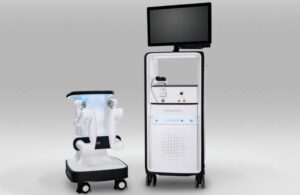
The latest advancement in Monarch navigation technology features AI-powered algorithms and a verified OEC open interface with GE HealthCare’s OEC 3D mobile CBCT imaging system. Johnson & Johnson MedTech submitted this technology to the FDA for 510(k) clearance last fall.
Monarch, the first robotic-assisted bronchoscopy system to market, offers minimally invasive access to and visualization of airways. It helps clinicians biopsy suspicious lung nodules. The platform helps deliver early, definitive diagnoses in lung cancer cases to get patients on the treatment pathway faster.
[For more on the wide world of surgical robotics, see our special report on the space.]
The Monarch Quest platform builds on the system’s stable reach and precision with a unique scope-in-sheath design and continuous vision, according to J&J MedTech. This software also integrates enhanced navigation with intraprocedural 3D imaging data, potentially improving accuracy in targeting lung nodules.
Additionally, Monarch Quest’s AI-powered navigation leverages the full-stack Nvidia accelerated computing platform. This increases its real-time computational power by 260%, allowing it to run complex algorithms to enhance accuracy and confidence. The company struck a deal with Nvidia around using AI in surgical robotics about a year ago. The platform also adds more AI capabilities for future Monarch software releases.
J&J MedTech says the digital capabilities in Monarch now extend from preoperative planning through intraoperative, AI-based navigation.
“Our goal with the Monarch Platform is to change the treatment paradigm for diseases such as lung cancer, where significant unmet needs still remain,” said Aleksandra Popovic, president, Monarch, Johnson & Johnson MedTech. “Monarch Quest demonstrates our commitment to delivering meaningful innovation that helps clinicians advance the standard of care for their patients.”