Johnson & Johnson (NYSE: JNJ) MedTech Executive Vice President and Worldwide Chairman Tim Schmid said the company is entering its next phase of growth with a sharper focus on surgical robotics, cardiovascular technologies and targeted portfolio management.
In a DeviceTalks West keynote interview today, Schmid said J&J MedTech is “leaning in” to high-growth areas of cardiovascular, surgery, and vision, while preparing to separate its orthopedics business into a standalone company.
J&J MedTech generated about $8.4 billion in revenue last quarter, growing 5.6% year-over-year, led by strong performance in cardiovascular technologies and steady gains in wound closure, surgical instrumentation and vision care.
“You never take a decision of that magnitude lightly, especially given the amount of patients who count on us, physicians who count on us in the orthopedic space, and the amount of very dedicated 15,000 employees that we have working in that business,” Schmid said. “But at the end of the day, it comes down to portfolio management, and our responsibility is to ensure that we’re continuously optimizing our portfolio to create value for our stakeholders, and we’ve been on a journey over the last couple of years to shift our portfolio from lower growth markets into higher growth markets.”
Robotics progress with Ottava and Monarch
Schmid said J&J’s plan is to “win across robotics,” outlining a multi-platform approach that includes both Ottava and the Monarch robotic systems. He said the company recently made an investment in a robotics company in China to advance a “cart-based” system tailored for regional surgical needs, a move he described as further evidence of J&J’s global commitment to robotics.
“That in no way suggests that we’re not committed to it; actually, it is a further doubling down on our commitment to win in surgical robotics in all markets,” Schmid said.
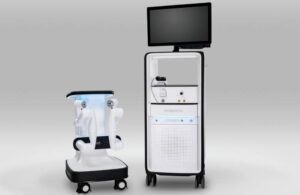
Schmid called Monarch “an incredible technology,” addressing a significant unmet need in lung cancer diagnosis, which remains one of the leading causes of cancer deaths worldwide. The system allows physicians to navigate a robotic bronchoscope through the airways using a handheld controller to reach deep regions of the lung that traditional tools cannot access. The device is designed to improve the precision and consistency of biopsies that determine early treatment options.
“What really matters in lung cancer is for patients to be diagnosed as quickly as possible, because the mortality and the survival, survival benefit of being diagnosed earlier are game changing,” Schmid said. “So what this technology allows us to do is go through the throat with the bronchoscope and … navigating the bronchoscope down into the confines and the branches of the lung, where most devices can never get to, to actually biopsy and determine what the path of treatment should be for that patient.”
Schmid added that J&J received 510(k) clearance earlier this year for Monarch Quest, an AI-enabled upgrade that enhances navigation and imaging capabilities on the Monarch Quest platform. The company also plans to extend Monarch into urology, with future applications aimed at treating kidney stones.
He also noted the company’s Ottava surgical robotics system remains a cornerstone of J&J’s digital surgery strategy. Ottava completed its first clinical use cases in 2025 after receiving FDA Investigational Device Exemption (IDE) approval in 2024. The system uses four robotic arms directly into a motorized operating table and is designed to reduce the footprint and improve workflow efficiency in the operating room.
“We believe that over the long term, it isn’t going to be the robot that wins in surgical robotics. It is all going to be about the data, how you collect that data and use it to provide physicians and healthcare professionals in the OR with better insights,” Schmid said.
The company plans to pursue regulatory submission in 2026, part of a multi-year effort to build a unified digital surgery ecosystem that combines Ethicon instrumentation, advanced visualization, and data analytics. Schmid said robotics will remain a long-term strategic priority for J&J, as it is positioned to complement the company’s existing surgical portfolio rather than replace it.
Refocusing the portfolio
Schmid said the upcoming spinoff of J&J’s orthopedics division represents the next step in the company’s portfolio transformation. The business, which generated roughly $9.2 billion in 2024 revenue, will operate under the DePuy Synthes name and is expected to complete its separation within two years.
The separation follows a series of actions designed to streamline operations and focus on higher-margin, innovation-driven categories. The move positions J&J MedTech to align more closely with global demand for minimally invasive and digital-enabled care.
Schmid said the company’s cardiovascular technologies continue to lead growth, driven by acquisitions of Abiomed and Shockwave Medical, which have expanded J&J’s presence in heart recovery and coronary therapies.

“We made a distinctive decision to say we’re going to play a bigger role in the cardiovascular space,” Schmid said. “These are the sickest patients… they’re also patients that create the greatest burden on health systems around the world.”
Schmid said J&J MedTech spent about $3.7 billion on R&D last year and invested more than $30 billion in acquisitions over the past six years, including the Abiomed and Shockwave deals. Through its JJDC venture arm, the company continues to back early-stage technologies across robotics, imaging and cardiovascular care.
“We’ve made a purchase of a company in the left atrial appendage space. We align that very much with our electrophysiology business,” said Schmid. “We made an acquisition in heart failure of a company called V-wave, which has created this amazing shunt, and we’ll align that with our failure business. In some cases, we’ll align [acquisitions] where we have capabilities and where we can leverage the scale of those businesses and other areas. We have now an opportunity to further expand in cardiovascular.”
Correction: An earlier version of this article noted Monarch plans to extend into neurology and urology, but has since been corrected.