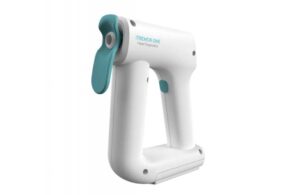
The iTremor One offers the rapid assessment and evaluation of brain impairment and brain disease. The three-second test is designed to identify a biomarker called ocular microtremor and deliver real-time neurological data, potentially aiding in the objectivity, accuracy and speed of diagnosis in conditions like traumatic brain injury (TBI), Parkinson’s, stroke and more.
Head Diagnostics spun out of Trinity College in Dublin, Ireland, in 2018. The company, which has been supported by Enterprise Ireland — the Irish government’s enterprise development agency — brought on CEO David Van Zuydam, who had a background in finance, licensing and technology and IP and sales and and growing markets, and had previously been with tech giant Microsoft.
(Learn more about Ireland’s role in the medtech industry here.)
Van Zuydam led the Trinity spin-off as it transitioned its initial technology into laser spectral metrology. Now, the company is looking at a submission to the FDA soon, with potential approval enabling it to pursue its goal of bringing its device to every physician out there.
“It’s a device that measures ocular microtremor, almost like a vital sign,” Zuydam told MassDevice in a recent interview. “Just like blood pressure is used for heart rate, we want to be a vital sign of brain function.”
In the interview with MassDevice, Van Zuydam explained Head Diagnostics’ technology and the company’s plans for the future.
The following has been lightly edited for space and clarity.
What is the mission of Head Diagnostics?
David Van Zuydam: “We are trying to help people live a healthier life for longer. That’s our ultimate vision and aim. By detecting disease early and cost-effectively, we can get them the right treatment and on the right pathways. We work across pharma, hospitals, doctor, surgeries, neuro clinics, etc. That’s where we want to bring almost the democratization of neurology into the mainstream. It can even eventually go out to your urgent care centers and even your pharmacies, where you can get testing and then make a decision as almost as a consumer, that you want to make that next step on your health. That’s where we play as a company.
“We are also building a wider neuro platform to incorporate other modules in our overall platform. We’re thinking of bringing about items like ADHD and autism testing in an all-encompassing neuro platform that could include items like gait assessment, etc. So, we will play across the whole neurological assessment.
“There’s also a big AI play here as well. There will be an underlying AI platform with all of this. … We’re now looking forward where we want to test digitally and then we can look at that data going forward, how we can predict disease, how we can find better efficacies with drugs, how we can help pharma companies make drugs better, etc. So having that digital platform on the line is huge. Our number one question from pharma is, ‘can we have the data?’ That’s where you decide on this big AI journey, and that’s where we’re going to be playing. We’ll be playing directly in this AI space.”
How did this company come to be?
DVZ: “When we first looked at ocular microtremor as a brain reflex marker, we were looking at how many people in the world knew about this marker, and there were very few. It started off back in the 70s, when a gentleman by the name of Davis Coakley was investigating what ocular microtremor was and what effect it had on the body, where it came from, and then almost looking at the pathways of ocular microtremor. … Trinity College was ready to see how they could get that into the market and that’s where I came in. I came in as a founder and said, ‘we like the concept of the technology. Now let’s build a medical device around that.’
About the Head Diagnostics technology
DVZ: “We use a laser spectral metrology method to measure the frequency of the eye with our handheld medical device. We’ve got a very sophisticated device where we measure, at the nano level, the micro movement of the eye. The eye is essentially wobbling, going laterally and vertically, getting signals off your brain stem and that’s what we measure. We measure that fine and involuntary movement that determines what’s going on in the brain at that point in time. It’s very innovative. It’s a coming together of electronics, imaging and physiological eye movement.
“Then, there’s beautiful technology around it that encompasses algorithms and things like that. We have everything in there that encompasses a really sophisticated medical device. It all comes together, with electronics, with algorithms, with actual science and imaging, something that’s physiologically available in every human. We all have an ocular microtremor in our eye, just like we have a heartbeat. The beauty about that was just what we can with this and try and get it mainstream and get it used by medical practitioners, neurologists and clinicians, then this could be very interesting for the world as a new marker of brain function.”
What were the difficulties in developing this technology?
DVZ: “First, we had to make it non-invasive. That was the first challenge. How do we move from piezoelectric to the next generation? Fortunately, some of the early scientific work on that, on laser spectral metrology, had been done in the university’s time through R&D. Then, it was about the accuracy of that vs. what is actually going on in the eye. Who’s going to believe us if we tell them that we shine a little, very low-level, non-invasive light on the eye, and we tell you what the frequency of the eye is? Because it’s such a complicated thing to do, it’s almost like measuring boiling water in some way, and it was proving that out clinically, where we actually did the tests.”
“Getting that validation was, for us, always the big question, and to prove to any of the doubters that this thing is real. And we did that with the device, and we have all the scientific evidence on that.”
Pulling it all together
DVZ: “Bringing all that technology, then, together in a single device, we’ve got a lot going on. We’ve got circuit boards, lasers, optics, algorithms, and we have to make all of that work together and we’ve got to make it safe. We’ve got to make it reliable and repeatable. All those are challenges on the way, until you get to a point where you say we’ve got the devices reliable, repeatable, a doctor a can use it. Then, what does it look like clinically? That’s what we bring into the world. We’re going to provide a device that can measure something, and then let the world decide how they want to use that. That’s what we can do.”
Getting the technology into the FDA’s hands
DVZ: “Once we’ve got [the technology], how do we get that through the FDA cycle? What clinical studies and evidence do we need? The FDA has been very receptive of our concept and ideas. We had a few pre-submission meetings with them already, even during some challenging times, and they have been very receptive, and feedback has been very good, and we’re going through that cycle now.
Once you get this into the hands of physicians, there’s no training needed, right?
DVZ: “Correct. I remember working for Microsoft; their vision was to have Windows on every PC in the world. Our vision, similarly, is to have an iTremor One device that measures ocular microtremor on every physician’s desk in the world. They can pick it up just like they pick up a stethoscope, just like they pick up a blood pressure monitor or even a knee reflex hammer. We want this device to be readily available and get that device into the market.
“The vision for everyone to have [the device] available to use in many applications where they see fit. It’s almost equated to BMI index. We know what a BMI index curve looks like, and we’ll know what an OMT curve looks like, potentially across different age groups, as we build massive datasets of people in the global population. We’ll know where you sit in your profile, and if you’re outside of that profile by a couple of standard deviations. Then, if you’re not in line with the normal population group, something is potentially happening neurologically, for that matter. Then, it’s out for the clinician to decipher where they go next, what blood tests they may do, what PET scan or MRI scan they may do after that, and what the next level of treatment may be.”
What’s next for Head Diagnostics?
DVZ: “We’ll be aiming to file [with the FDA] between December and January. Typically, the average turnaround time for the FDA is 90 days. Because we’ve had a number of FDA meetings, we would expect to have an approval three months post-application. That’s what I expect, that’s what the expectation is. You could argue that around about May-time, we’d like to see a device available in the market for use in the U.S.”
Could you also elaborate on the company’s licensed tech from Philips?
DVZ: “In July, we signed an exclusive global license with Philips for their novel digital cognition assessment platform. This platform is a full-stack digital neurocognition platform that can assess patients across six domains of the brain, some of them being things like working memory, executive function, visual, spacial, etc.”
“The idea where we acquired the license was that if we can get these early diagnostics done to suggest that the patient can then go for an MRI scan, PET scan for amyloid, there’s new blood tests, we’d be the first port of call on that. We don’t position ourselves in the market as a brief screener tool. We are a comprehensive neuro-psych test that really complements the neuropsychologist in their work. So, we can digitize, all that workflow for the neuroscience test, get a lot of people coming through digital testing, get the results across six domains of the brain, and then make the immediate decision on the blood test, the PET scan, and then essentially going for the infusion on the disease modifying therapies. That’s why we we acquired that license from Philips.”
What are the plans for that technology?
DVZ: “We’re very excited about it. We look into roll it out globally and have a number of very active discussions, and you’ll see that product in the market very shortly, across different countries. The product itself is clinically validated in the United States across two clinical trials. We have the regulatory piece, and then you look at what the product is like to use. All the clinicians and even the patients using the product say the UX interface is exceptional. Phillips left no stone unturned when they built that product out. The UX interface and the design of that is very simple to use and, to get the results, it’s instant. It’s instant from the cloud. Neurologists, clinicians, technicians and doctors can all use the product.

