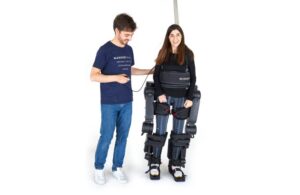
Wandercraft announced today that the FDA expanded the indications for its flagship Atalante X rehabilitation device.
Atalante X, a self-balancing robotic exoskeleton system, features a powered ankle mechanism. It can perform complex ankle movements that enable wearers to mimic a natural human gait. This helps therapists better assist patients in their rehabilitation.
Clearance comes just weeks after the New York-based robotic exoskeleton developer received expanded CE mark approval as well. The FDA expanded Atalante X’s indications to include individuals with spinal cord injury (SCI) from levels C4 to L5 and in those with multiple sclerosis (MS). This broadens access to upright, hands-free gait therapy.
Atalante X received its initial FDA clearance in early 2024 for people with SCIs at levels T5 to L5. Wandercraft has since advanced its Personal Exoskeleton platform as well, for which it enrolled one of the first participants in a clinical trial earlier this year. The company also brought in $75 million in funding this past summer to support its platforms.
Currently, more than 100 rehabilitation and research centers worldwide use Atalante X. It has enabled thousands of patients to take more than 1 million steps per month, Wandercraft said in a news release. The company used findings from a multicenter, retrospective study of 547 training sessions for patients with high-level SCI to support the expanded labeling.
“This extension of indication for Atalante X marks a significant advance in neurorehabilitation and patient access to technology that enables them to walk again,” said Matthieu Masselin, CEO of Wandercraft. “It enables therapists to personalize training for complex patients, now going as far as to the joint level, and help even more people with severely limited upper-body strength to experience upright movement safely and confidently – something which many thought was impossible.”
More on the expanded indications for the Wandercraft Atalante X
According to Wandercraft, traditional exoskeletons require users to bear weight with crutches or walkers. That excludes those with limited upper-limb or trunk control. Atalante X’s self-balancing design eliminates that limitation, so clinicians can initiate upright training, even with severely impaired patients.
The upgraded Atalante X system now includes joint-specific assistance control, too, with independent tuning at each hip and knee motor. Its step-length adjustments come in 5% increments to enable fine, progressive adaptation to each patient’s motor profile.
Wandercraft also said the system now features enhanced graphical data in patient reports and updated training protocols for clinician onboarding. Its refined hardware components include more durable foam support as well.
Altogether, the company says Atalante X can address critical needs through hands-free, self-balancing ambulation powered by AI. It enables clinicians to safely retrain gait and posture in patients unable to support themselves with crutches or walkers.
“Atalante X restores the possibility of upright movement for patients once thought to be too impaired to walk again. We’re building technology that brings humanity back into rehabilitation,” said Masselin. “This extension of indication also further validates Wandercraft’s unstoppable momentum as a force in the global medical device market, today in rehab and next year at home.”