The test is cleared for people 55 and older with signs of cognitive decline to be used in conjunction with clinical information in assessing Alzheimer’s risk.
When the FDA approved the first Alzheimer’s blood test last year, Yale Medicine explained that such tests are important because they enable health providers to diagnose the disease sooner. The only medications presently approved for Alzheimer’s disease — Esai and Biogen’s Leqembi (lecanemab) and Eli Lilly and Co.’s Kisunla (donanemab) — only slow progression of the condition in its early stages.
Roche lists three investigational Alzheimer’s drugs in its pipeline: trontinemab, nivegacetor and RG6627. Trontinemab, a Brainshuttle-enabled amyloid antibody is currently in Phase 3 trials, while nivegacetor, an oral gamma-secretase modulator, is in Phase 2. RG6627 is an APOE-targeted antisense oligonucleotide, currently in Phase 1.
“FDA clearance of Elecsys pTau217 marks an important milestone in Alzheimer’s disease diagnosis and underscores Roche’s continued leadership in advancing innovative solutions that can help patients get answers sooner,” Dan Malarek, President and CEO of Roche Diagnostics North America, said in a press release. “As the first and only FDA-cleared, single-biomarker blood test supporting both rule-in and rule-out assessment of amyloid pathology, Elecsys pTau217 has the potential to transform how Alzheimer’s is assessed across primary and specialty care. This kind of innovation can help bring diagnostic evaluation closer to patients and give clinicians greater confidence in determining the right step in their care.
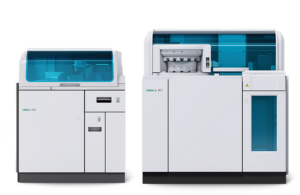
The test, which was developed in collaboration with Eli Lilly, can be used across Roche’s cobas laboratory instruments in the U.S., the company said, and provides positive, intermediate and negative result categories. The assay’s safety and effectiveness for predicting development of dementia or other neurologic conditions or for monitoring treatment response have not been established.
“For decades, clinicians have faced significant challenges in accurately diagnosing Alzheimer’s disease in its early stages. While PET imaging and cerebrospinal fluid biomarkers can confirm amyloid pathology in patients with cognitive impairment, these approaches may be costly, invasive and not readily accessible for many patients,” Jared R. Brosch, M.D., Neurologist, Indiana University Health, said in a press release. “Advances in blood-based biomarkers have the potential to transform the diagnostic pathway by expanding access to evaluation for Alzheimer’s across a variety of care settings. As these tools become available, clinicians may be able to evaluate more patients earlier in the disease course, improving diagnostic confidence and helping patients and their families make more informed decisions at a critical time.”
The Elecsys pTau217 test demonstrated high agreement with amyloid PET imaging, Roche said.
The pTau217 test received Breakthrough Device Designation in 2024. The FDA also cleared Roche’s pTau181 test for primary-care rule-out only in 2025.